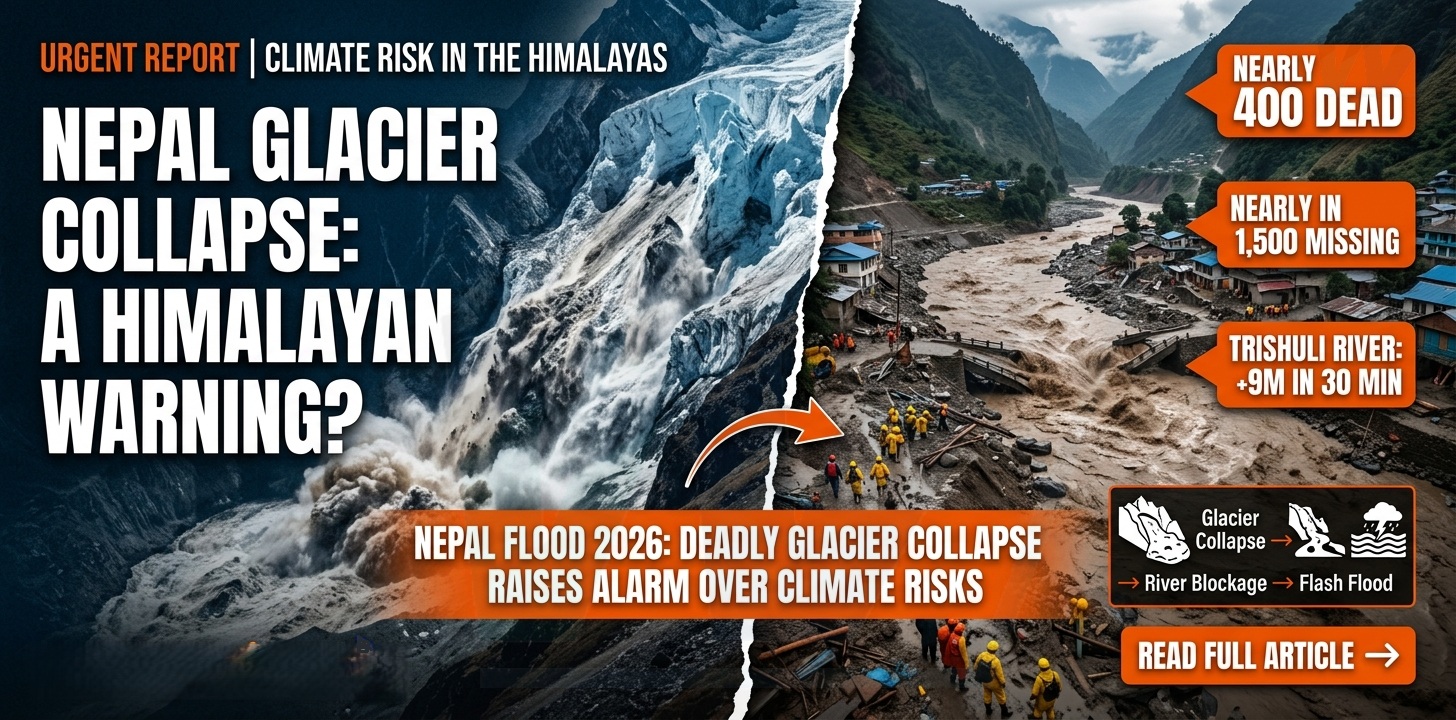
Nepal Flood 2026: Deadly Glacier Collapse Raises Alarm Over Himalayan Climate Risk
A Glacier Collapsed. A River Exploded. Is This the New Himalayan Normal?
A catastrophic flash flood on the Nepal–Tibet border has killed nearly 400 people and left about 1,500 missing, renewing fears that a warming Himalaya is entering a more dangerous era.
KATHMANDU, August 28, 2026 — In minutes, a Himalayan valley became a torrent.
On August 26, a massive collapse of ice, rock and debris triggered a devastating flash flood along the Nepal–Tibet border. Rivers surged, bridges disappeared, roads were destroyed and communities were buried beneath mud and debris.
By August 28, reports put the combined death toll at nearly 400, with around 1,500 people still missing. Rescue operations remain underway, while authorities warn that unstable debris-dammed lakes could create additional flooding.
When a Glacier Becomes a Weapon
The disaster was initially thought to have been triggered by an earthquake. Scientists later determined that the seismic signal came from a massive glacial collapse and debris flow.
Satellite analysis indicated that part of a glacier in the Langtang Lirung region collapsed from roughly 5,200 meters, sending enormous quantities of ice and rock into the valley.
The impact transformed the landscape.
The resulting surge entered the Lhende Khola and Bhote Koshi river systems before racing downstream. The Trishuli River reportedly rose by around 9 meters in just 30 minutes.
For communities in narrow Himalayan valleys, that leaves almost no time to escape.
The Danger Is Not Over
The flood may have created a second threat.
Debris has blocked waterways and formed unstable lakes capable of holding huge volumes of water. If those natural barriers fail, another destructive flood could sweep downstream.
The chain of danger is becoming familiar:
Glacier collapse → landslide → river blockage → sudden release → flash flood.
And potentially, another flood.
Climate Change: Cause or Warning?
Scientists caution against claiming that climate change directly caused this glacier collapse.
But the broader picture is alarming.
The Hindu Kush Himalaya is warming rapidly. Glaciers are retreating, permafrost is weakening and unstable mountain slopes are becoming increasingly vulnerable to landslides, ice avalanches and sudden floods.
Nepal’s glaciers have lost a significant share of their ice in recent decades, while researchers warn that glacier-related hazards are becoming an increasingly important climate risk across the Himalayas.
The crucial issue is therefore not whether every glacier collapse is caused by climate change.
It is whether a warmer Himalaya is creating conditions in which cascading disasters become more likely and harder to predict.
A Warning for Asia
The Himalayas are more than a mountain range. They are a critical water source for hundreds of millions of people and support villages, cities, hydropower projects, highways, tourism and international trade.
That makes the Nepal disaster a regional warning.
A collapsing glacier can destroy a bridge.
A destroyed bridge can isolate communities.
A blocked river can create a new flood threat.
And a disaster can cross borders within hours.
Early-warning systems, satellite monitoring, river sensors and cross-border information sharing could save lives—but when a mountain collapses suddenly, the warning window may be measured in minutes.
The Question Now Is What Happens Next
Rescue teams continue searching through mud and destroyed infrastructure as authorities monitor unstable slopes and newly formed lakes.
But the biggest question extends far beyond the current death toll:
How many other Himalayan communities are living beneath unstable glaciers, and how much warning would they receive before the next collapse?
Nepal’s catastrophe may be a single disaster.
But scientists increasingly see it as something larger:
A glimpse of what a warmer, less stable Himalaya could look like.
The mountains are changing.
And the time to prepare may be running out.