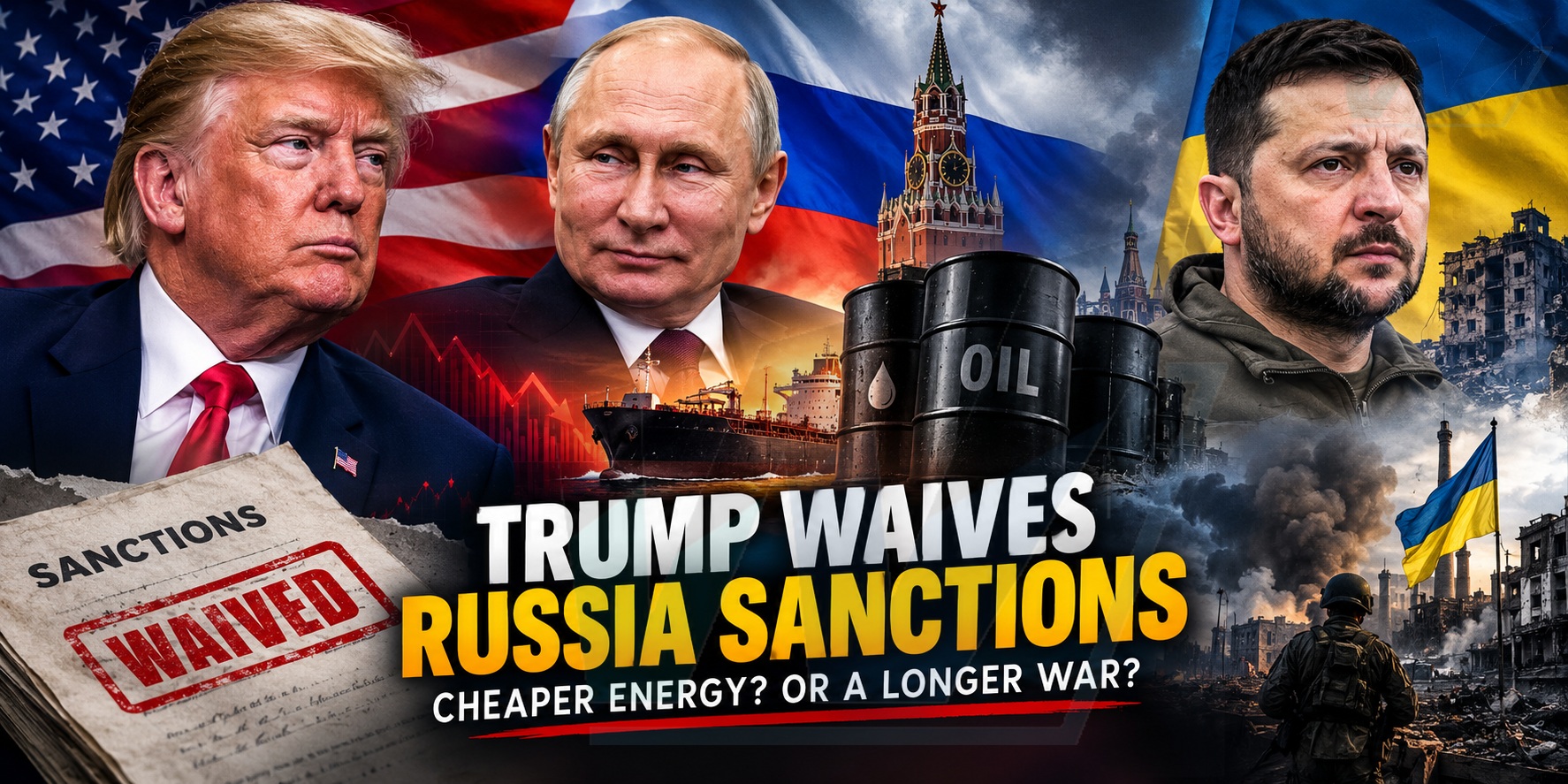
Trump’s Russia Sanctions U-Turn: Putin Gets Economic Relief as Ukraine and Europe Sound the Alarm
President Donald Trump has waived key provisions of a bipartisan Russia sanctions law just days before they were due to take effect, triggering a transatlantic political storm and raising a critical question: Is Washington prioritizing lower fuel prices over pressure on Vladimir Putin to end the war in Ukraine?
The executive order, signed on October 16, suspends major sanctions, restrictions and tariffs under the Lindsey O. Graham Sanctioning Russia and Iran Act of 2026. The White House cites US national interests, but the order does not publicly spell out the underlying justification in detail. Reuters, The Associated Press, The Guardian and other international outlets reported the decision and its immediate political fallout.
The Sanctions Reversal: What Trump’s Order Changes
The law was designed to turn Russia’s energy trade into a source of leverage against the Kremlin. Instead, Trump has used the waiver mechanism written into the legislation to postpone or neutralize many of its most consequential new penalties.
Signed into law in September, the Graham Act authorized:
- Up to 500% tariffs on Russian-origin goods entering the United States, subject to statutory exceptions.
- Up to 100% tariffs on goods from major purchasers of Russian oil and gas and countries facilitating sanctions evasion, under specified conditions.
- Additional restrictions targeting Russian officials, financial networks and vessels associated with the so-called shadow fleet.
The executive order waives the application of numerous provisions while directing US officials to monitor Russian energy purchases and recommend further action if necessary. Crucially, this does not abolish all existing US sanctions against Russia. Earlier sanctions imposed under separate executive orders remain in place unless independently changed.
Why Now? Diesel, Oil Prices and the Midterm Election Countdown
The timing is central to the controversy.
Trump has argued that additional Russian diesel supplies could help ease pressure on global fuel markets. Earlier in October, he announced an arrangement under which Russia would supply hundreds of thousands of tons of diesel initially, followed by additional shipments.
The administration’s calculations are unfolding against a broader energy crisis. The war involving Iran and disruption risks around the Strait of Hormuz have intensified concerns about fuel availability, while attacks on Russian and Ukrainian energy infrastructure have added uncertainty.
Energy analysts have warned that additional Russian supplies may offer some relief but cannot, by themselves, resolve a crisis involving wider shipping disruptions and geopolitical risk.
There is also a domestic political dimension. With US midterm elections approaching in November, high fuel prices and the cost of living are major political liabilities. The waiver could help the administration pursue additional fuel supplies, although it remains uncertain how much the policy will reduce prices for American consumers.
The central dilemma is stark: Washington wants cheaper energy without surrendering its leverage over Moscow. Whether those goals can coexist is now an increasingly urgent question.
Washington Erupts: Bipartisan Pressure Meets Presidential Power
The decision has provoked sharp criticism from lawmakers who supported the sanctions legislation.
Representative Don Beyer, a Virginia Democrat, accused Trump of undermining Ukraine and disregarding Congress’s intent. Senator Elizabeth Warren described the move as a serious failure of leadership, arguing that it weakens pressure on the Kremlin.
Senator Richard Blumenthal also condemned the waiver, saying the administration was rewarding Putin rather than holding Russia accountable.
The backlash extends beyond the Democratic Party. The legislation had attracted bipartisan support, and the Associated Press reported that the president’s decision has generated anger among lawmakers who wanted stronger economic pressure on Moscow. However, an immediate legislative reversal appears difficult while Congress is away from Washington.
The conflict is therefore not simply a disagreement over Russia. It is a test of how Congress can exercise its foreign-policy authority when the president invokes a statutory power to waive measures that lawmakers approved.
Kyiv’s Alarm: Is Putin Gaining Room to Fight?
For Ukraine, the consequences extend far beyond tariffs.
President Volodymyr Zelenskyy has opposed Washington’s growing willingness to accommodate Russian energy exports, warning that today’s diesel arrangements could open the door to further sanctions relief.
Ukrainian officials fear that increased opportunities to sell energy will help Moscow sustain its war economy. Oleksandr Merezhko, chairman of Ukraine’s parliamentary foreign affairs committee, condemned the decision, while Ukrainian presidential adviser Vladyslav Vlasiuk criticized the move publicly.
The concern is particularly acute because the sanctions reversal comes amid an increasingly strained relationship between Trump and Zelenskyy. Washington has criticized Ukrainian attacks on Russian refineries, while Kyiv argues that strikes on Russian energy infrastructure are a response to continued Russian attacks against Ukrainian cities and power facilities.
Another flashpoint involves military communications. Reports of restrictions affecting Ukraine’s military satellite connectivity have heightened fears about the reliability of US support. The precise circumstances surrounding those restrictions remain contested, and the sanctions waiver does not itself establish a direct link between the two developments.
For Kyiv, however, the combined effect is unmistakable: uncertainty over energy policy, military communications and the future of American assistance.
Moscow’s Reaction: An Opening for Economic Relief
Russia has welcomed the American shift.
Russian presidential envoy Kirill Dmitriev described the decision as a significant, historic moment, arguing that the sanctions package could otherwise have severely constrained economic cooperation between Washington and Moscow.
The potential benefits for the Kremlin are substantial. If Russian energy exports can reach additional buyers without the threatened new penalties, Moscow could face less pressure to discount its oil and refined products or restructure transactions to avoid sanctions.
Nevertheless, the order should not be mistaken for a complete normalization of US-Russia relations. Existing sanctions remain, and the administration retains the ability to reconsider its waivers. Financial institutions and commercial partners may therefore remain cautious about entering transactions that could become exposed to renewed restrictions.
The immediate victory for Moscow is not the disappearance of every Western sanction. It is the removal of a new layer of threatened economic pressure at a moment when the Kremlin is seeking revenue and diplomatic room to maneuver.
Europe Watches Nervously as Ukraine Looks for Alternatives
European governments face difficult strategic calculation.
On one side, they want stable energy supplies and relief from economic pressures. On the other, they fear that easing restrictions on Russian exports could weaken the economic campaign intended to constrain Moscow’s invasion of Ukraine.
Recent European reporting points to growing concern over the burden of financing Ukraine if US support becomes less dependable. European leaders have been exploring ways to address Ukraine’s future funding requirements while continuing to debate the scale and distribution of assistance.
The sanctions waiver could intensify calls for Europe to assume greater responsibility for Ukraine’s military and financial survival. But Europe’s capacity to replace American intelligence, weapons and strategic capabilities remains a separate and formidable challenge.
For countries on NATO’s eastern flank, including Bulgaria, the wider implications involve not only energy and trade but also deterrence and Black Sea security. The policy debate is therefore relevant well beyond Washington, Kyiv and Moscow.
What About Israel and the Middle East?
The immediate decision concerns Russia, but the administration’s energy calculations are also shaped by the wider conflict involving Iran and the vulnerability of Gulf shipping routes.
The Strait of Hormuz is a critical artery for global energy supplies. Disruptions there can increase the cost of crude oil, refined fuels, shipping and insurance, creating inflationary pressure far beyond the Middle East.
Israel’s security environment and the wider regional confrontation matter to the energy equation because prolonged instability can undermine supply reliability and intensify competition for available fuel. Yet the sanctions waiver is not, by itself, evidence of a new Israeli policy or a direct change in US commitments to Israel.
The connection is strategic rather than automatic: as Washington seeks to contain energy costs during multiple international crises, its decisions on Russia increasingly intersect with its calculations in the Middle East.
What Happens Next? Three Questions Could Decide the Outcome
-
Will Congress challenge the waiver?
Lawmakers could pursue legislation, hearings or other oversight measures. Whether they can secure sufficient bipartisan support to force a change remains uncertain.
-
Will Russian diesel actually lower fuel prices?
The impact will depend on delivered volumes, refining capacity, shipping costs, market conditions and the scale of disruption elsewhere. A political announcement is not the same as a sustained increase in affordable supply.
-
Will economic relief bring Putin closer to negotiations?
The administration may hope energy cooperation creates diplomatic leverage. Critics fear the opposite: that Moscow will gain additional resources without making meaningful concessions in Ukraine.
The Bottom Line: A High-Stakes Gamble with Ukraine’s Future at Risk
Trump’s decision marks a significant reversal in the effort to increase economic pressure on Russia. By waiving much of the new sanctions package before its October 18 implementation deadline, the president has prioritized flexibility over immediate enforcement.
The administration may argue that fuel supplies, diplomatic engagement and national economic interests justify the move. Its critics counter that easing pressure without securing concessions risks strengthening the very government the sanctions were designed to constrain.
For Ukraine, the fear is that the cost of Washington’s energy strategy could be measured not only in dollars, but in lost leverage, weakened deterrence and a longer war.
For Europe, the challenge is to preserve support for Kyiv while managing energy costs and strategic uncertainty. For Moscow, the opening offers welcome relief, but not immunity from the sanctions that remain.
The decisive question now is whether Trump’s Russian energy gamble can deliver tangible economic benefits and progress toward peace, or whether Putin will gain breathing room while Ukraine pays the price.