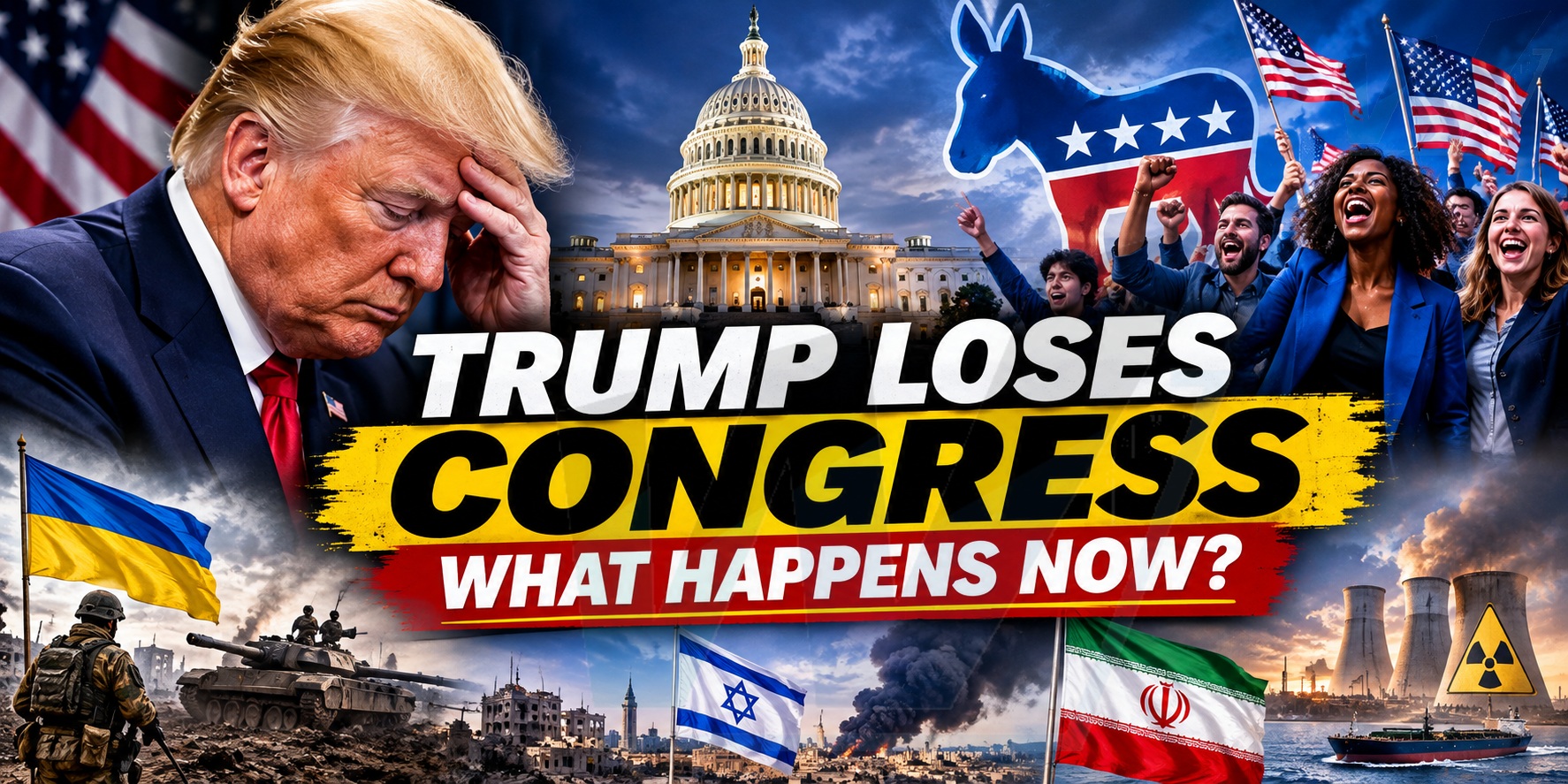
A Political Earthquake in Washington: What Trump’s Midterm Defeat Means for Ukraine, Russia and Israel.
Washington’s Power Struggle Begins: Could Congress Force Trump to Change Course on Iran and Russia?
Trump Still Controls the White House, But Democrats Now Hold the Purse Strings. What Happens Next?
From the war in Ukraine to the confrontation with Iran, the Strait of Hormuz and Israel’s security, America’s midterm earthquake could redraw the political boundaries of global diplomacy. Trump still controls the White House, but Democrats now hold Congress.
WASHINGTON — The political earthquake has struck Washington. In a stunning midterm defeat for President Donald Trump, Democrats have seized control of both the House of Representatives and the Senate, threatening to turn the final two years of his presidency into an unprecedented battle over power, money, military operations and America’s role in the world.
The November 3 elections delivered a sweeping Republican defeat, driven by voter frustration over the cost of living, Trump’s leadership and the economic consequences of the war with Iran. The Associated Press called the Senate for Democrats on election night and the House in the early hours of November 4.
The consequences reach far beyond American politics.
Ukraine is watching for renewed military assistance. Moscow faces a potentially tougher Congress. Israel could encounter greater scrutiny over American military support. Lebanon may find new diplomatic opportunities, while Tehran faces mounting pressure over its nuclear programme and the strategic Strait of Hormuz.
The central question is no longer whether Trump has suffered a political defeat. It is whether Democrats can use their new power to change the course of America’s most dangerous international confrontations.
A new Congress, a weakened White House: What can Democrats do?
The victory creates a divided government: a Republican president facing Democratic majorities in both legislative chambers.
Once the new Congress takes office on January 3, 2027, Democrats will have five powerful weapons:
- The money: Control over federal appropriations gives Congress leverage over military assistance, defense spending and foreign aid.
- The investigations: Congressional committees can summon officials, demand documents and investigate administration decisions.
- The Senate: Democrats can block presidential nominees, including senior diplomatic and national-security appointments.
- The legislation: Lawmakers can impose sanctions, establish conditions on assistance and challenge executive policies.
- Impeachment: The House can impeach Trump, although conviction and removal require a two-thirds Senate majority.
The Council on Foreign Relations identifies spending, oversight, nominations and sanctions as the principal congressional instruments capable of influencing Trump’s foreign policy.
But Trump retains the presidency, command of the armed forces and veto power. Democrats lack the supermajorities needed to override a presidential veto.
Washington is heading towards two years of confrontation, negotiation and potential legislative paralysis.
Ukraine and Russia: A possible lifeline for Kyiv?
For Ukraine, the election could open a new political window.
Democrats are expected to push for stronger support for Kyiv, including military assistance, air-defense capabilities, intelligence cooperation and continued pressure on Moscow.
The timing is critical.
The United States is preparing to host trilateral negotiations involving Ukraine and Russia in Abu Dhabi on November 10–11. Discussions are expected to cover a possible end to the war, post-war security guarantees, humanitarian arrangements and de-escalation.
The new Democratic majority could make it harder for Trump to negotiate an agreement that Congress considers excessively favorable to Vladimir Putin.
For Russia, the calculation becomes more complicated: sanctions relief and American acceptance of territorial concessions could face stronger congressional resistance.
But Trump still controls the diplomatic initiative.
The danger for Kyiv is that Trump may accelerate pressure for a peace agreement before Democrats formally take power. The opportunity is that a new Congress could provide Ukraine with greater political and financial backing if negotiations collapse.
Israel: Is unconditional American support coming under pressure?
Israel faces a potentially more difficult relationship with Washington.
A Democratic-controlled Congress could intensify scrutiny of American military assistance, weapons transfers, operations in Gaza and the West Bank, and the humanitarian consequences of the conflict.
It could also seek conditions on future arms deliveries and demand stronger diplomatic efforts to prevent regional escalation.
However, an immediate American break with Israel is unlikely. The strategic relationship remains deeply established, and Democrats themselves are divided over military assistance and Israel’s security.
The likely change is political rather than immediate military: Israel may increasingly have to defend its policies before a more critical American Congress.
Lebanon: A new opportunity for sovereignty and security?
For Lebanon, the election could have significant consequences.
Democratic lawmakers may push for stronger support for the Lebanese Armed Forces, greater scrutiny of military operations affecting Lebanese territory and renewed diplomatic efforts to prevent another war between Israel and Hezbollah.
Three issues could dominate:
- Strengthening the Lebanese Army and the authority of the Lebanese state.
- Monitoring American weapons transfers and their use in regional military operations.
- Supporting diplomatic arrangements that protect Lebanon’s sovereignty and prevent renewed hostilities.
Washington’s position on Hezbollah is unlikely to change fundamentally. The United States continues to designate Hezbollah as a terrorist organization.
Nevertheless, greater congressional scrutiny could create opportunities for Beirut to seek stronger international backing for Lebanese state institutions and reconstruction.
For Lebanon, the question is whether Washington’s political shift can translate into a genuine diplomatic effort to prevent another devastating confrontation.
Iran and the Strait of Hormuz: Will Congress challenge Trump’s war?
This is arguably the most immediate test of the new political balance.
The war with Iran has become a major source of domestic political pressure on Trump, with rising energy costs and disruptions to international shipping contributing to Republican losses.
On November 8, Trump told CNN that he was highly unlikely to order further strikes if negotiations progressed, although he warned that American forces had identified potential infrastructure targets.
Meanwhile, military incidents involving commercial vessels and oil tankers continued around the Strait of Hormuz. Qatar said diplomatic efforts were continuing, while Iran had submitted a nuclear proposal to Washington through Qatari mediators.
Democrats could demand investigations into the war, challenge additional military funding and push for negotiations.
But they cannot simply order American forces to withdraw.
Trump retains substantial executive military authority, and any attempt to impose binding restrictions through legislation could face a presidential veto.
The Strait of Hormuz makes the stakes global. A prolonged confrontation threatens energy supplies, shipping routes, insurance costs and international economic stability.
The new Congress could make Trump’s war considerably more difficult to finance and defend politically. Whether it can force him to end it is another question entirely.
Nuclear weapons: The most dangerous calculation
Beyond the immediate conflicts lies a potentially catastrophic risk: nuclear escalation.
The confrontation with Iran, Russia’s war in Ukraine and the deterioration of international arms-control arrangements create several overlapping security challenges.
Democrats could demand:
- Greater scrutiny of Iran’s nuclear programme.
- Renewed diplomatic negotiations with Tehran.
- Stronger oversight of American nuclear modernization.
- New arms-control initiatives with Russia.
- Measures to reduce the risk of accidental military escalation.
However, congressional control does not give Democrats operational authority over America’s nuclear arsenal.
The president retains extensive authority over nuclear command decisions.
The new Congress can increase oversight and promote diplomacy, but it cannot automatically take the nuclear launch decision away from the president.
Europe, NATO and Bulgaria: Will Washington become more predictable?
European governments may welcome a Congress more supportive of Ukraine and NATO, but uncertainty surrounding Trump’s decisions will remain.
Germany, France, Britain and the European Union will be watching three developments:
- Whether American military assistance to Ukraine increases.
- Whether Washington maintains its commitment to NATO and European security.
- Whether Trump’s negotiations with Putin preserve Ukraine’s sovereignty.
For Bulgaria and NATO’s eastern flank, the consequences are particularly important. A stronger American congressional commitment to Ukraine could reinforce regional deterrence, while continued uncertainty may accelerate European defense spending.
Russia, meanwhile, could face a more complicated American negotiating environment.
The election has not eliminated Trump’s influence over NATO, but it has given Congress a stronger voice in determining how American resources and political support are used.
The next battle: January 3, 2027
The political transition will not happen overnight.
The outgoing Congress remains in place until January 3, 2027. That leaves a critical period for Trump to pursue diplomatic initiatives, negotiate funding and attempt to secure foreign-policy achievements before Democrats assume control.
The immediate pressure points are:
Date |
What to watch |
| November 10–11 | US-mediated Ukraine-Russia negotiations in Abu Dhabi |
| December 11 | Federal government funding deadline |
| December 2026 | Defence spending and military-policy negotiations |
| January 3, 2027 | Democratic Congress formally takes office |
The bottom line: Trump has the White House. Democrats have the keys to Congress.
The 2026 midterm elections have transformed America’s political landscape, but they have not transferred presidential power.
For Ukraine, the outcome could mean renewed American support.
For Russia, it could mean greater resistance to concessions.
For Israel, it could mean more conditional military and diplomatic support.
For Lebanon, it could create opportunities for stronger international backing for state sovereignty.
For Iran, it could increase pressure on Washington to negotiate rather than escalate.
And for the world, it raises a fundamental question: can America maintain a coherent international strategy when its president and Congress are controlled by opposing political forces?
Trump still commands the White House. Democrats now control both chambers. Between them stand Ukraine, Russia, Israel, Lebanon, Iran, the Strait of Hormuz and the nuclear balance.
The next two years could determine whether Washington becomes a force for diplomatic de-escalation, or another source of global uncertainty.