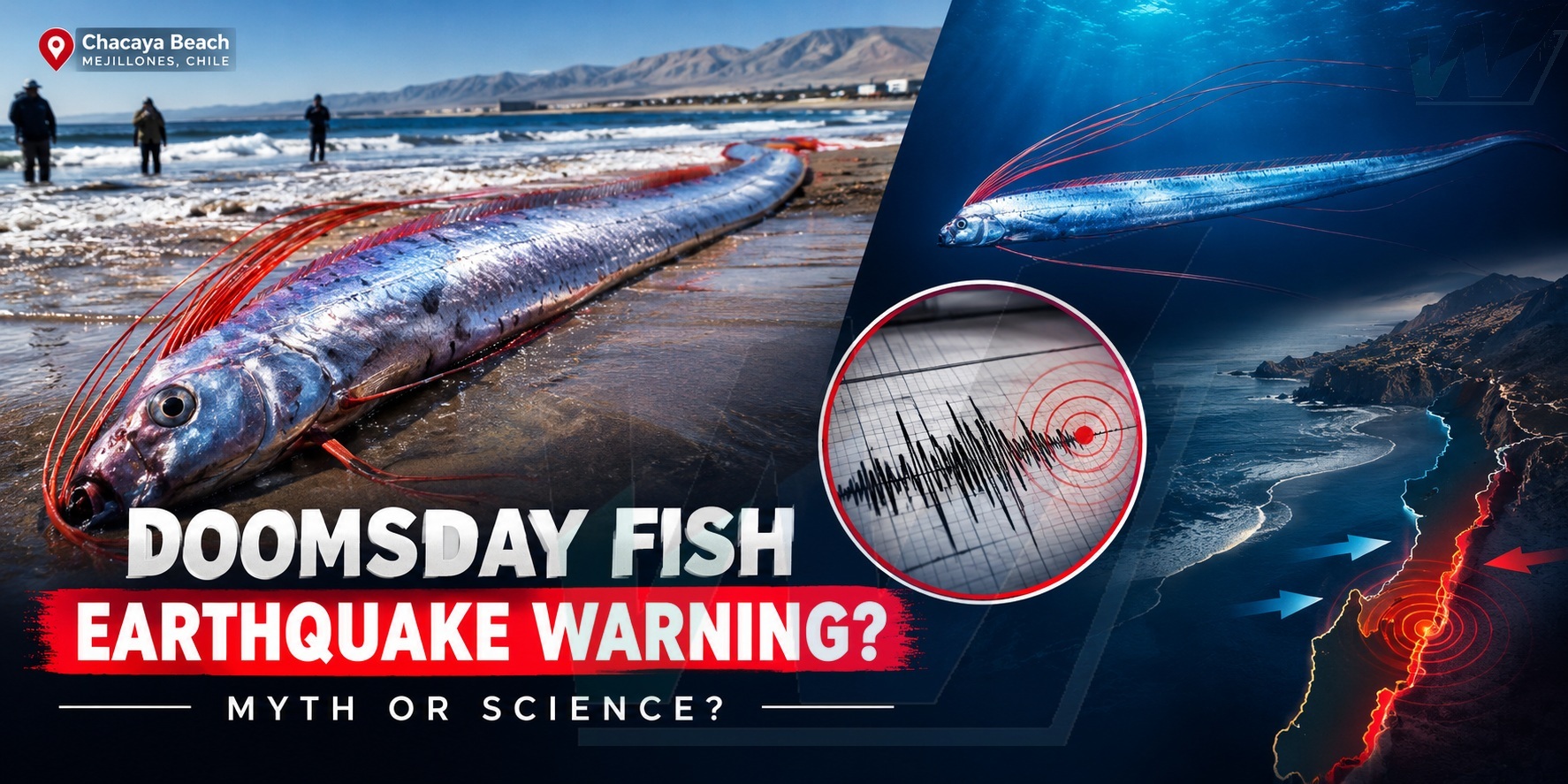
Chile’s Doomsday Fish: Does the Rare Oarfish Predict Earthquakes?
Myth or Warning? The “Doomsday Fish” Returns to the Spotlight Off Chile’s Coast
A rare, five-meter oarfish found dead on Chile’s northern coast has revived an unsettling legend. But does its appearance warn of an impending earthquake or tsunami?
MEJILLONES, CHILE
A mysterious silver giant has washed ashore in northern Chile, and an ancient legend is spreading faster than the facts.
The rare oarfish, estimated to measure around five meters, was found dead at Chacaya Beach, about 25 kilometers south of Mejillones, according to local reporting published by SoyChile on October 22. The discovery has reignited online speculation about the creature’s ominous nickname: the “Doomsday Fish.”
For generations, folklore has linked sightings of this deep-sea fish to earthquakes and tsunamis. But in a country shaped by powerful seismic activity, a frightening legend is not the same as a scientific warning.
There is no reliable scientific evidence that an oarfish sighting predicts an imminent earthquake or tsunami.
The discovery that revived an ancient fear
The oarfish is one of the ocean’s most unusual inhabitants: a long, ribbon-like fish with a silvery body and distinctive reddish fins. It typically lives in deep water, making sightings near the surface or along coastlines rare and captivating.
Its extraordinary appearance has helped fuel the belief that it carries a message from the depths.
In Japan, the fish is known as Ryūgū-no-tsukai, often translated as “Messenger from the Palace of the Sea God.” Traditional stories associate its appearance with impending disasters. When an unusual sighting is followed by an earthquake, the two events can become linked in public memory, even when evidence does not establish a connection.
That is how a rare marine encounter can become a viral warning.
Scientists tested the ‘Doomsday Fish’ theory
The legend has not gone unexamined. A 2019 study published in the “Bulletin of the Seismological Society of America” investigated whether deep-sea fish appearances were meaningfully associated with major earthquakes in Japan.
Researchers compared historical records of deep-sea fish sightings with earthquake data, examining whether significant earthquakes occurred close to the sightings in both time and distance.
The study found no reliable relationship strong enough to support using these fish as earthquake predictors.
The distinction matters: a coincidence can attract attention, but a dependable warning system must demonstrate a consistent, measurable relationship. The available evidence has not established one for the oarfish.
Why would a deep-sea fish wash ashore?
There is no single confirmed explanation for every oarfish sighting or stranding. Illness, injury and environmental or oceanographic conditions may play a role, but the cause of the Chilean fish’s death cannot be established without appropriate examination and field evidence.
The specimen may therefore be more valuable as an opportunity for scientific investigation than as a supposed forecast for disaster.
Chile’s real earthquake risk
Chile sits along one of the world’s most active tectonic boundaries, where the Nazca Plate moves beneath the South American Plate. The immense geological forces generated along this boundary can produce devastating earthquakes and tsunamis.
That risk is real, but it is explained by tectonic processes, not by folklore surrounding a rare fish.
Scientists cannot reliably predict the exact time, location and magnitude of an individual earthquake. An oarfish sighting is not an official seismic alert, and it should never replace information from Chilean authorities or established monitoring agencies.
Myth, mystery and evidence
The discovery at Chacaya Beach offers a compelling glimpse of a little-seen deep-sea species. It also exposes how quickly an extraordinary image can become a story of impending catastrophe.
The fish is real. The legend is centuries old. The claim that it predicts earthquakes remains scientifically unproven.
For people living in earthquake-prone regions, preparedness should be guided by official alerts, sound safety planning and geological evidence, not viral speculation.
The ocean still holds mysteries. But when it comes to predicting the next disaster, evidence matters more than omens.