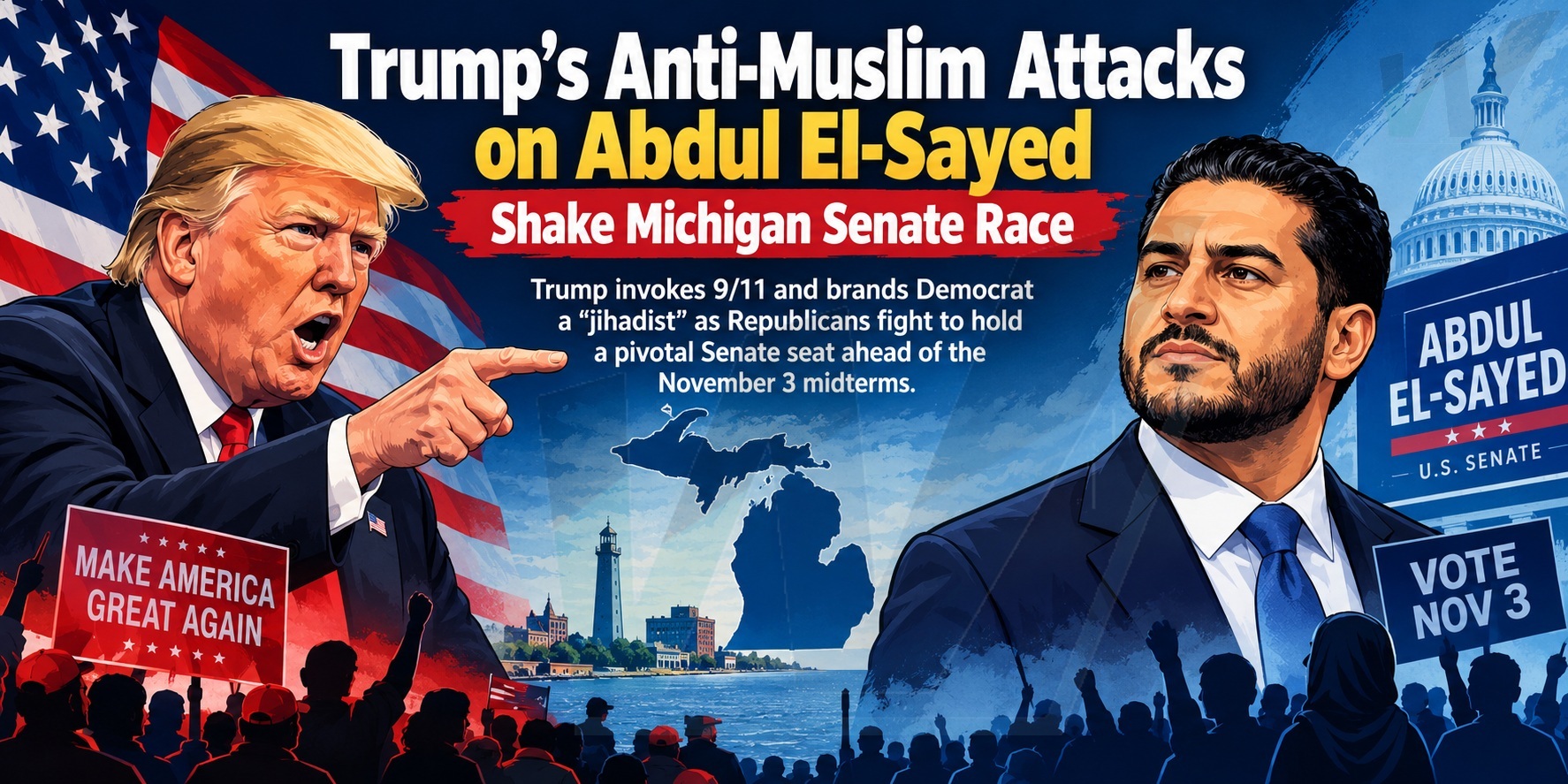
Trump’s Anti-Muslim Rhetoric Explodes in Michigan as Senate Race Enters Final Days
Trump invokes 9/11 and brands Democrat Abdul El-Sayed a “jihadist” as Republicans fight to hold a pivotal Senate seat ahead of the November 3 midterms.
PORT HURON, Michigan
With control of the U.S. Senate hanging in the balance, President Donald Trump has escalated his attacks on Democratic candidate Abdul El-Sayed, invoking the September 11 terrorist attacks and portraying the Muslim American as a national security threat during a fiercely contested campaign rally in Michigan.
Speaking in Port Huron on Sunday, October 25, Trump called El-Sayed a “jihadist” and alleged that he belonged to the Muslim Brotherhood, claims the Democratic candidate has repeatedly denied. Trump also suggested El-Sayed should face extraordinary security restrictions if elected, turning a Senate contest into a confrontation over religion, national identity and political loyalty.
The remarks, delivered just nine days before the November 3 midterm elections, drew condemnation from Arab American voices, including a former ally who helped mobilize support for Trump in 2024. The controversy has intensified scrutiny of the Republican campaign strategy in a state where even a narrow shift in voter turnout could influence control of the Senate.
A Senate campaign turns into a battle over identity
“I’m here to keep a jihadist, Muslim Brotherhood member from becoming a United States senator,” Trump told supporters.
He went further by invoking United Flight 93, whose passengers fought back against hijackers during the September 11, 2001, attacks. Trump compared the effort to stop El-Sayed from entering the Senate to the passengers’ resistance, framing the Democratic candidate as a danger to the country.
The president also suggested El-Sayed should be subjected to a metal detector before entering the Senate chamber.
The allegations have not been substantiated. The Associated Press reported that there is no evidence establishing El-Sayed’s affiliation with the Muslim Brotherhood, while Reuters reported that he has repeatedly rejected claims questioning his allegiance to the United States.
El-Sayed, a former public health official born in the United States to Egyptian immigrant parents, could become the first Muslim elected to the U.S. Senate if he wins the race.
The significance of the attacks extends beyond one candidate. By repeatedly emphasizing El-Sayed’s Muslim faith and Egyptian heritage, Trump has placed religious identity at the center of a campaign that is also being shaped by economic anxiety, immigration, national security and dissatisfaction with the direction of the country.
Backlash from a former Trump ally
One of the most politically significant reactions came from Bishara Bahbah, a founder of Arab Americans for Trump, an organization that helped the president reach Arab American voters during the 2024 election.
Bahbah condemned the president’s remarks as racist and unacceptable, warning that the comments crossed a line.
His criticism carries weight in Michigan, where Arab American voters have emerged as an important political constituency and where divisions over U.S. policy in the Middle East have already reshaped electoral loyalties.
The city of Dearborn and surrounding communities have become closely watched battlegrounds. Trump’s ability to attract voters dissatisfied with the Biden administration’s handling of the Gaza war helped him make historic gains among Arab American voters in 2024.
The latest controversy threatens to test whether those gains can survive a campaign increasingly centered on attacks against a Muslim candidate.
The consequences may extend beyond November 3. Alienating Arab American and Muslim voters could complicate Republican efforts in Michigan, while inflammatory rhetoric could also strengthen Trump’s appeal among supporters who respond to hardline messages about immigration, terrorism and national security.
Whether that strategy ultimately increases Republican turnout or drives away potential supporters remains uncertain.
Mike Rogers faces pressure as the race tightens
Republican Senate nominee Mike Rogers, a former congressman backed by Trump, is competing against El-Sayed for the seat being vacated by retiring Democratic Senator Gary Peters.
The contest is among the races that could determine which party controls the Senate after the midterms.
Rogers has repeatedly questioned El-Sayed’s political associations and echoed allegations linking him to the Muslim Brotherhood. However, when asked about Trump’s characterization of his opponent as a terrorist on NBC’s Meet the Press, Rogers said he had never called El-Sayed a terrorist.
That distinction has not ended with questions about how closely Rogers is willing to associate himself with the president’s rhetoric.
The Republican candidate must balance Trump’s ability to energize conservative voters against the political risks of being tied to a president whose approval ratings and economic record have become vulnerabilities for the party.
Trump won Michigan in 2024, but a presidential victory does not guarantee that Republican Senate candidates will prevail in a midterm election. Voters may approach the contest differently when choosing a president’s congressional allies, particularly when economic pressures dominate their daily lives.
Democrats try to redirect the debate toward household costs
El-Sayed has sought to shift attention away from allegations about his faith and background and toward the economic concerns facing Michigan families.
His campaign has emphasized affordability, health care and the cost of living, arguing that personal attacks do little to address rising expenses.
At a campaign event in Grand Rapids on Sunday, El-Sayed pushed back against Trump’s rhetoric and suggested the president’s fixation on his name and identity was a distraction from questions affecting ordinary Americans.
Senator Bernie Sanders, who appeared at the Democratic event, also criticized the Republican strategy, arguing that attacks on Muslims and political opponents were displacing debate over health care, housing, income inequality and the economy.
The political contrast is clear: Republicans are attempting to make El-Sayed’s alleged associations and national security credentials a central issue, while Democrats are seeking to make the election a referendum on the economy and Trump’s leadership.
Yet El-Sayed’s campaign has also faced scrutiny over his past statements and political associations. The candidate has apologized for earlier remarks that critics interpreted as excusing an attack on a Detroit-area synagogue. His opponents have cited such controversies to challenge his judgment and positions.
Those disputes form part of a bitter campaign in which both sides have questioned the other’s credibility and political loyalties.
A critical test for Michigan’s Arab American voters
Michigan’s political landscape makes confrontation especially consequential.
The state combines major industrial communities, working-class voters, suburban battlegrounds and significant Arab American and Muslim populations. Its electoral coalitions can shift when national controversies intersect with local economic pressures or U.S. foreign policy.
Trump’s 2024 gains among Arab American voters demonstrated that dissatisfaction with Democratic policies could overcome established voting patterns. But his latest remarks have reopened questions about whether voters who previously supported him will remain aligned with Republicans.
For El-Sayed, the challenge is equally complex. He must defend himself against allegations he denies while maintaining a coalition that includes progressive Democrats, younger voters, Arab Americans and constituents whose views on Israel, Gaza and national security may differ sharply.
The contest is therefore about more than the personal fortunes of two Senate candidates. It is a test of how religious identity, foreign policy and economic frustration interact in American elections.
The final question: Will Trump’s intervention help Republicans?
Trump’s Port Huron appearance followed a Democratic campaign event in Detroit featuring former President Barack Obama, who criticized efforts to portray El-Sayed as less American than his opponents.
The rival appearances highlighted Michigan’s importance in the closing stretch of the campaign. They also exposed two competing strategies: Republicans are seeking to mobilize their base through national security warnings and attacks on El-Sayed, while Democrats are attempting to unite voters around affordability, health care and opposition to Trump’s agenda.
The president’s speech offered plenty of political confrontation but no major new economic commitment specifically for Michigan, according to the Associated Press. Rapper Nicki Minaj appeared at the rally, adding celebrity attention to an event dominated by Trump’s attacks on the Democratic nominee.
The electoral impact remains uncertain. Trump’s supporters responded enthusiastically to his remarks, but a charged rally crowd cannot establish whether the strategy will persuade undecided voters or increase turnout enough to change the outcome.
With Election Day approaching, the central question is whether the president’s rhetoric will energize Republicans or deepen resistance among voters who see the attacks as an attempt to turn a policy debate into a test of religious identity.
For Michigan, the answer could help determine control of the Senate. For the wider United States, the campaign has become another high-profile test of the boundaries of political rhetoric, religious tolerance and the meaning of American belonging.