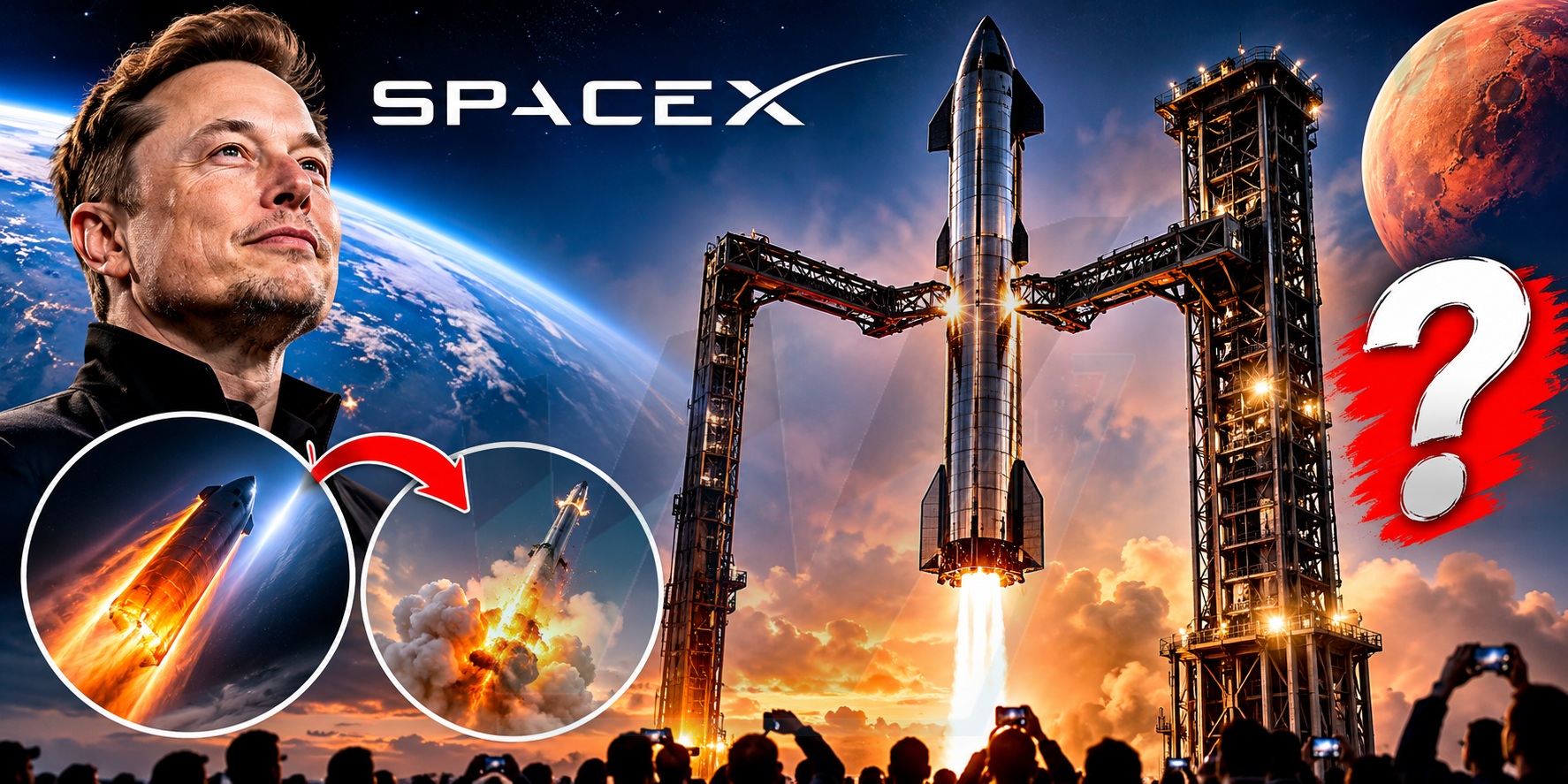
SpaceX Makes History: Starship Returns from Orbit and Gets Caught by Giant Robotic Arms
Space X Starship’s Historic Catch: First-Ever Mid-Air Recovery of a Spacecraft Returning from Orbit, Elon Musk’s Mars Dream Takes a Giant Leap
After 14 revolutions around Earth, Starship pulled off an extraordinary return, slipping into the mechanical arms of its launch tower in a historic first. But a failed booster recovery exposed the challenges still standing between Elon Musk’s vision and fully reusable spaceflight.
The sky over South Texas became a front-row seat to a moment that could redefine the future of space exploration.
On Saturday, November 14, SpaceX’s Starship emerged from the clouds, its heat-shield tiles glowing after atmospheric re-entry. It dropped towards its Texas launch site, fired its engines, flipped upright and slowed to an almost motionless hover.
Then came the moment engineers had spent years trying to achieve.
Two enormous mechanical arms nicknamed “Mechazilla’s chopsticks”, closed around the spacecraft and caught it in midair.
No runway. No landing legs. No ocean recovery.
For the first time, a Starship spacecraft returning from space had been caught directly by its launch tower.
The crowd erupted. Mission commentators struggled to contain their excitement. Elon Musk’s ambitious vision suddenly looked a little closer to reality.
But the celebration came with an important qualification: Starship had made it home. Its booster had not.
22 Hours in Space, Then A Perfectly Timed Catch
The historic maneuver followed SpaceX’s 15th full-scale Starship test flight, launched on Friday, November 13, from Starbase, near Brownsville, Texas.
Standing approximately 407 feet (124 meters) tall, the two-stage rocket is the most powerful launch vehicle ever built.
Its mission was designed to achieve something even more ambitious than previous tests: recover both stages at the launch site, making the entire system reusable.
The spacecraft separated successfully from its Super Heavy booster and continued towards orbit.
During its journey, Starship deployed 26 advanced Starlink satellites, travelled approximately 165 miles (265 kilometers) above Earth and completed 14 revolutions around the planet.
After approximately 22 hours in space, it began its return.
The most dangerous part was still ahead.
As it plunged through the atmosphere, friction generated intense heat across its protective heat shield. Cameras mounted on the spacecraft captured spectacular views of the glowing vehicle as it descended towards the Gulf Coast.
Then, in the final moments, its Raptor engines restarted.
The spacecraft rotated from its horizontal descent into a vertical position, slowed dramatically and aligned itself with the launch tower.
The mechanical arms moved in.
Starship was caught.
The Booster Exploded, But the Spacecraft Survived
The spectacular recovery almost overshadowed the mission’s biggest setback.
SpaceX had hoped to achieve a double catch: recovering both Starship and its Super Heavy first-stage booster.
That plan collapsed shortly after Friday’s launch.
The booster encountered problems during its return, with an onboard guidance system determining that the vehicle was not correctly positioned for a safe tower capture. Its engines also shut down earlier than expected.
Instead of returning to Starbase, the booster diverted towards the Gulf of Mexico, where it exploded shortly before reaching the water.
SpaceX said engineers were investigating the failure.
Musk subsequently attributed the loss to engine underperformance, while indicating that the early-generation vehicles were already being overtaken by improved designs.
The distinction matters.
SpaceX had previously demonstrated three successful Super Heavy booster catches. What it had never achieved before was catching the upper-stage Starship itself after an orbital mission.
Flight 15 therefore delivered a historic breakthrough, but not a complete recovery of the launch system.
Why Two Giant Arms Could Change Space Travel
The technology behind the catch is more than a spectacular engineering stunt.
SpaceX’s mechanical tower system is designed to recover rockets directly at the launch site, allowing them to be inspected, refurbished and prepared for another flight.
Traditional rockets often discard expensive stages into the ocean or allow them to burn up during re-entry.
SpaceX wants to change that equation.
Its ultimate ambition is to make Starship rapidly reusable, potentially allowing launch operations to become more frequent while reducing the cost of sending satellites, equipment and eventually humans into space.
The successful recovery of the upper stage represents a critical missing piece.
However, catching a spacecraft once does not prove that it can be reused safely and economically on a regular basis. Engineers must still demonstrate repeated recoveries, reliable heat-shield performance, rapid refurbishment and consistent flight operations.
In other words, the spectacular catch was a beginning, not the finish line.
Nasa’s Moon Plans Are Watching, And Mars Is the Bigger Dream
The implications extend far beyond SpaceX.
NASA is relying on Starship technology as part of its Artemis programme, which aims to return astronauts to the lunar surface and establish a more sustained human presence around the Moon.
Under NASA’s current plans, Starship is intended to serve as a human lunar lander, transporting astronauts between lunar orbit and the Moon’s surface.
The challenge is enormous.
Before Starship can perform that role, SpaceX must demonstrate orbital refueling, transferring propellant between spacecraft in orbit, a capability essential to supplying the fuel needed for a lunar journey.
Multiple tanker flights are expected to support the process.
NASA’s lunar ambitions also face the challenge of competing development schedules. Blue Origin’s Blue Moon lander is another key part of the programme, giving the agency an alternative pathway.
The stakes are high: NASA is targeting 2028 for Artemis IV, which is intended to deliver astronauts to the lunar surface.
And beyond the Moon lies Musk’s ultimate ambition.
He wants Starship to transport people and supplies to Mars, eventually helping establish a permanent human settlement there.
That vision remains far from reality. But every successful test brings engineers closer to understanding what such a transportation system would require.
The Next Test: Can Space Become Routine?
The significance of November 14 is not simply that a giant rocket was caught by two mechanical arms.
It is that SpaceX demonstrated a new way of bringing an orbital spacecraft back to the exact launch infrastructure from which it departed.
The company has now shown that its upper stage can survive an orbital mission, withstand atmospheric re-entry, perform a controlled engine-powered landing maneuver and be recovered directly by its launch tower.
But the failed booster recovery is a reminder that the system remains under development.
The next challenge is to turn a spectacular one-time achievement into a repeatable, reliable and affordable operation.
For the aerospace industry, the message is unmistakable: the race to make rockets reusable has entered another chapter.
For NASA, it could help unlock the next era of lunar exploration.
For Musk, it is another step towards a much bigger destination.
And for the rest of the world, the images from Starbase offer a glimpse of a future in which rockets may no longer be disposable machines, but spacecraft designed to fly, return and fly again.
The spacecraft went to orbit. It came back. And the tower caught it.
The Moon may be next. Mars remains the dream. But on November 14, 2026, the future of reusable spaceflight suddenly looked a lot less like science fiction.