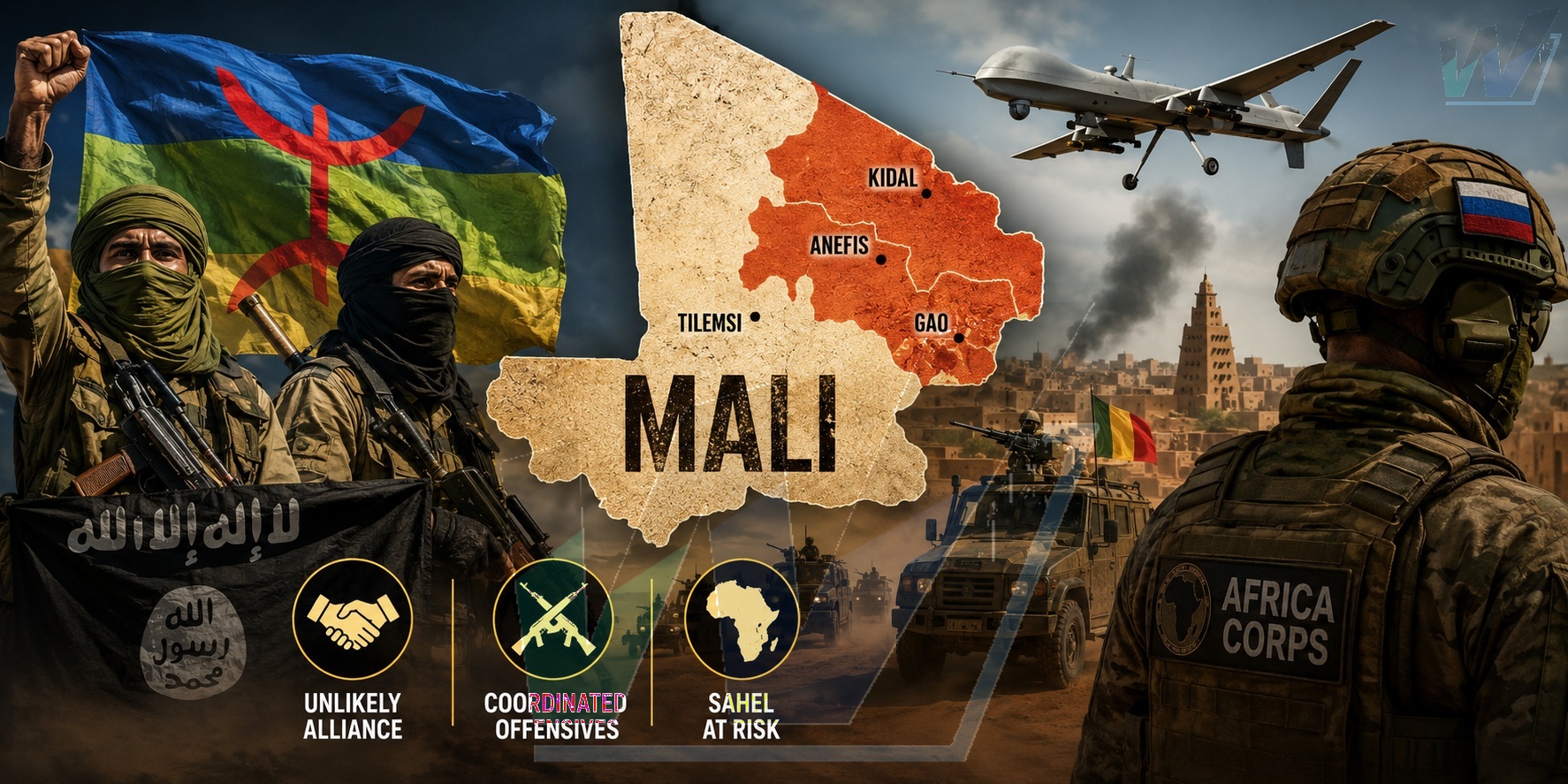
Mali’s Northern War Enters a Dangerous New Phase as Separatists and Al-Qaeda Allies Challenge Bamako and Russia
The battlefield is changing fast. A fragile alliance between Tuareg separatists and an al-Qaeda-linked insurgency has transformed Mali’s war into a three-sided struggle with consequences that could reverberate across the Sahel.
BAMAKO, Mali — The war in northern Mali has entered a dangerous new phase.
What was once a fragmented conflict between the Malian state, Tuareg separatists and jihadist groups has evolved into something far more unpredictable: a battlefield partnership between the Azawad Liberation Front (FLA) and Jama’at Nusrat al-Islam wal-Muslimin (JNIM), an al-Qaeda-linked militant coalition.
Their objectives remain fundamentally different. Their vision of Mali’s future is incompatible. Yet, for now, a common enemy has brought them together.
And that alliance is changing the balance of power.
The consequences were exposed dramatically during the coordinated offensive launched in late April, when attacks struck military positions and strategic locations across Mali, including the north and areas closer to the capital. The offensive killed Mali’s defense minister, Sadio Camara, according to reporting at the time, and demonstrated an unprecedented level of coordination between Tuareg separatists and jihadist forces.
Since then, the fighting has not settled. Instead, it has become more complex.
The latest clashes around strategic routes and towns such as Anefis have reinforced the central lesson of the new war: the Malian army and its Russian-backed allies may possess superior air power and heavier military capabilities, but they are struggling to control the vast distances, fragile supply lines and shifting alliances that define northern Mali.
The result is a conflict that increasingly resembles a war of movement, one in which territory can change hands, convoys can be ambushed and military bases can be isolated long before reinforcements arrive.
A marriage of convenience between enemies
On paper, the alliance between the FLA and JNIM should not exist.
The FLA represents the latest incarnation of a long-running Tuareg separatist movement seeking self-determination — and, for many of its supporters, independence — in northern Mali, a region known by separatists as Azawad.
JNIM, meanwhile, is an al-Qaeda-affiliated jihadist coalition seeking to overthrow governments it considers illegitimate and expands its influence through an Islamist political and military project.
The two movements have previously fought one another.
Yet northern Mali has repeatedly demonstrated that ideological differences can be temporarily subordinated to battlefield necessity.
The pattern is not entirely new. Tuareg rebels and jihadist factions cooperated during the 2012 rebellion before their alliance eventually collapsed under the weight of competing ideologies and ambitions. In July 2024, separatists and JNIM-linked fighters again coordinated in a major ambush against Malian and Russian forces near Tinzaouaten.
The latest partnership, however, appears broader and more operationally sophisticated. Analysts cited by Al Jazeera described the relationship as a pragmatic arrangement based on a shared enemy and overlapping local networks rather than a genuine political merger.
That distinction may prove decisive.
The FLA wants to be seen as a nationalist movement fighting for the political future of northern Mali. JNIM seeks a far more expansive transformation of the state and society.
For the moment, both sides appear to have concluded that cooperation is more valuable than confrontation.
The question is how long that calculation can survive.
From one rebellion to a national security crisis
The alliance has expanded the geography of the war.
The latest offensives have demonstrated the ability of armed groups to strike simultaneously across distant locations, forcing the Malian military to divide its forces between northern strongholds, central military installations and vulnerable supply routes.
The strategy is simple in concept but difficult to defeat: stretch the army, isolate its positions, attack its convoys and force it to respond everywhere at once.
In northern Mali, geography is itself a weapon.
Distances are enormous. Roads are limited. Military convoys can travel for hours through exposed terrain. A force that controls a town may still struggle to secure the roads leading to it.
The July fighting around Anefis highlighted precisely that vulnerability. The strategic town lies along routes connecting major northern military centres and has become a focal point in the struggle for access between the Gao and Kidal regions. Recent attacks have again exposed the vulnerability of military movements despite the presence of Russian-backed forces and increased use of drones and air power.
The battlefield is no longer defined only by the capture of towns.
It is increasingly defined by who can move, and who can stop movement.
Russia’s Africa Corps faces a new test
For Bamako, the crisis is also a test of its decision to abandon its former Western security partnerships and turn decisively toward Moscow.
Following the 2020 military coup and subsequent deterioration of relations with France and other Western partners, Mali expanded military cooperation with Russia. Wagner personnel were later replaced by the state-linked Africa Corps.
The strategic promise was clear: Russian military support would help the junta reclaim territory, defeat jihadist groups and restore state authority.
But the latest developments have exposed the limits of that strategy.
Russia-backed forces have provided aircraft, drones, weapons and combat support. The Malian army retains a significant advantage in air power. Yet military technology has not solved the underlying problem of controlling territory across a vast and hostile environment.
Recent setbacks, including the loss and contestation of strategic northern positions, have raised questions over whether air power can compensate for weak ground control, intelligence failures and vulnerable logistics. Le Monde reported that the April crisis exposed serious difficulties for Mali’s military partnership with Russia, including the loss of Kidal and the withdrawal of Africa Corps personnel from the area.
The Kremlin’s challenge is therefore becoming increasingly complicated.
Russia can help Mali fight.
But it cannot easily solve the political crisis that created the war.
The collapse of the peace process left a vacuum
At the heart of the conflict lies the failure of politics.
The 2015 Algiers Peace Agreement was designed to end years of fighting between Bamako and northern armed groups by offering greater decentralization, political representation and a framework for integrating former combatants.
Instead, implementation repeatedly stalled.
The agreement eventually collapsed amid growing distrust between the government and northern movements. Military coups further transformed the country’s political landscape, while Mali’s relations with regional and Western institutions deteriorated.
The military government in Bamako has consistently rejected any outcome that could threaten Mali’s territorial integrity.
The FLA, meanwhile, insists that the question of Azawad cannot simply be erased.
JNIM rejects the political system altogether.
Three actors. Three visions. One battlefield.
And no obvious compromise.
That is why the current conflict is so difficult to resolve. A military victory by Bamako would not automatically eliminate separatist grievances. A separatist advance would not necessarily produce a stable independent state. And a JNIM victory would transform the political order far beyond the question of northern autonomy.
War has therefore become more than a struggle over territory.
It is a struggle over the meaning of sovereignty itself.
A war economy is keeping the conflict alive
The battlefield is sustained by networks that existed long before the latest offensive.
Across the Sahel, armed groups have benefited from cross-border trade routes, illicit economies, taxation, local financial networks and access to weapons circulating through the region.
The collapse of Libya in 2011 accelerated the movement of arms across the Sahara, giving armed groups access to weapons that continue to circulate more than a decade later.
Now, battlefield capture has become another source of military strength.
Weapons, vehicles and equipment seized from Malian forces can be turned against the army itself.
The result is a vicious cycle: every military defeat can strengthen the opponent.
JNIM has also benefited from long-established financing networks, while separatist groups rely on local community, tribal and commercial support. The precise scale of illicit financing remains difficult to verify, but the conflict economy is clearly embedded in the region’s cross-border networks.
In a war fought across thousands of kilometers, money, fuel, weapons and information can be as important as soldiers.
The alliance’s greatest strength may also be its greatest weakness
The FLA-JNIM partnership is powerful precisely because it is temporary.
Its strength lies in the fact that both groups can contribute different capabilities.
The separatists possess deep local knowledge, community networks and familiarity with the northern terrain.
JNIM brings a wider insurgent network, experience in asymmetric warfare and the ability to operate beyond the traditional separatist theatre.
Together, they can force Bamako to confront threats in multiple directions.
But the alliance contains the seeds of its own collapse.
The FLA wants national recognition for a separatist project.
JNIM wants to overturn the political order and expand an Islamist system.
Those goals may coexist on a battlefield.
They are much harder to reconcile in government.
The history of northern Mali is filled with alliances that collapsed once a common enemy weakened or disappeared. The same fault line could eventually emerge again.
For now, however, Bamako remains the force holding the alliance together.
The Sahel is watching
The consequences of Mali’s new conflict will not stop at its borders.
The country sits at the center of a region already destabilized by jihadist insurgencies, military coups, collapsing Western partnerships and growing Russian involvement.
Burkina Faso and Niger face their own security crises. Armed groups operate across borders. Smuggling networks move through the same vast desert corridors. Fighters and weapons can travel across frontiers that national armies struggle to control.
A stronger JNIM presence in northern Mali could therefore affect security across the wider Sahel.
A successful separatist campaign could also encourage other movements to conclude that military pressure, rather than negotiations, is the only route to political concessions.
And a prolonged Russian-backed counteroffensive could deepen the region’s emerging confrontation between military governments aligned with Moscow and armed movements seeking to exploit the weaknesses of the state.
The danger is not simply that Mali may lose more territory.
It is that the conflict could become a model.
No endgame in sight
Three months after the April offensive, the fundamental political positions remain unchanged.
Bamako insists on a unified Mali.
The FLA continues to demand independence or a political settlement recognising the distinct aspirations of Azawad.
JNIM remains committed to overthrowing the government and expanding its own ideological project.
The military balance remains fluid.
The Malian army and Africa Corps possess superior air power and heavier weapons. The FLA and JNIM retain mobility, local networks and the ability to launch coordinated attacks across vast distances.
Neither side has achieved a decisive victory.
And neither has been forced to compromise.
That is what makes the current phase so dangerous.
The conflict has entered a period in which the battlefield can change faster than diplomacy can react.
A town can fall. A convoy can disappear. A military alliance can fracture. A separatist movement and an al-Qaeda affiliate can fight side by side, until the moment their shared enemy is no longer enough to hold them together.
The war has changed, but the political question remains
Mali’s northern conflict is no longer simply a rebellion against Bamako or an insurgency against the state.
It has become a collision between separatism, Jihadism, military rule and foreign power projection.
The FLA-JNIM partnership has demonstrated that ideological enemies can cooperate when the battlefield demands it. Russia’s involvement has shown that external military support can strengthen a government without necessarily resolving the political crisis beneath the war. And the collapse of the peace process has left the country without a credible framework capable of addressing the competing demands of sovereignty, autonomy and security.
The central question is no longer only whether Mali’s army can retake territory.
It is whether any actor can build a political settlement capable of surviving the ambitions of all the forces now fighting for Mali’s future.
For the moment, the answer appears to be no.
And as the guns continue to echo from Kidal and Anefis toward Gao, the conflict is entering its most dangerous phase yet, one in which yesterday’s enemies may become tomorrow’s allies, today’s battlefield victory may become tomorrow’s ambush, and the war itself may continue long after the original reasons for fighting have been forgotten.