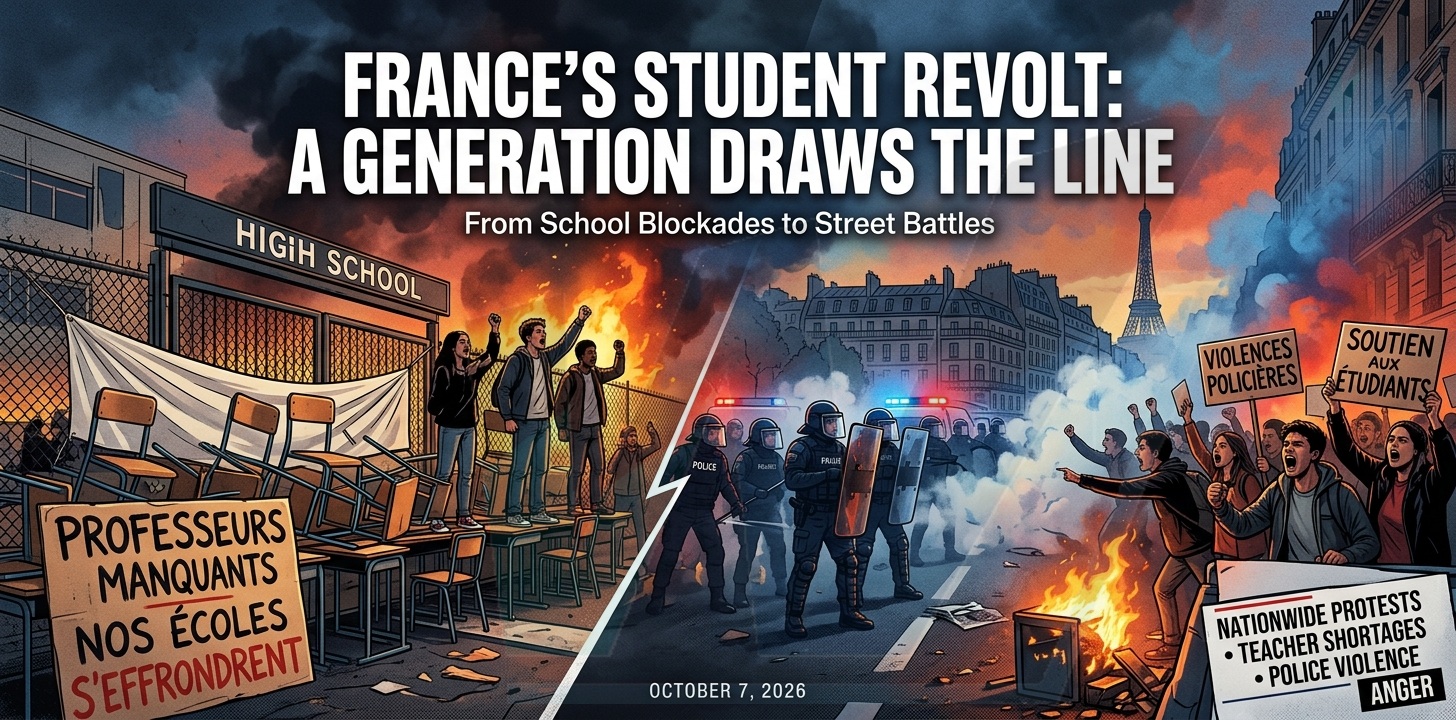
From School Blockades to Street Battles: France’s Youth Revolt Enters a New Phase
France’s Education Crisis Ignites a Youth Uprising as Police Violence Fuels Anger
France on Edge: Students, Teachers and Unions Join a Growing Education Revolt
More than 266,000 people rally nationwide as a school revolt over teachers, overcrowded classrooms and crumbling buildings collides with a growing backlash over police violence
PARIS, October 7, 2026
France’s schools have become the frontline of a rapidly widening national revolt.
What began in September as high-school blockades over missing teachers, overcrowded classrooms and deteriorating buildings have exploded into one of the country’s biggest youth protest movements in years. On Tuesday, October 6, more than 266,000 people took part in nationwide demonstrations, according to France’s Interior Ministry, including about 56,000 in Paris. Organizers put the national figure as high as 450,000.
The numbers tell only part of the story.
Behind the barricades is a generation increasingly convinced that the public education system is failing and that the government is listening only after the streets have filled.
Students complain of teacher shortages, overcrowded classes, punishing schedules, neglected school buildings and classrooms made increasingly difficult to use during extreme heat. The movement has also broadened to include university students, teachers, parents, trade unions and supporters from across the political spectrum.
And then came the police response.
From school gates to street battles
The movement began around September 21 in the Paris region and spread rapidly through social media and student networks. By October 1, more than 1,000 high schools had been affected, with hundreds blockaded.
By Tuesday’s nationwide “Act III,” the confrontation had become much bigger.
Police fired tear gas in Paris and other cities. Nearly 500 people were detained on Tuesday alone, while the Interior Ministry said more than 6,500 people had been arrested since the movement expanded, the overwhelming majority minors. About 43 police officers were injured during Tuesday’s demonstrations.
The government has also reported serious injuries among students and education workers. Prime Minister Sébastien Lecornu said 215 students and 85 school staff had been injured, alongside more than 700 police officers, as the confrontation intensified.
Some of the injuries have transformed the political argument.
In Lens, a 15-year-old student lost his hand after a police grenade exploded during unrest near a high school. In Saint-Ouen-l’Aumône, a 14-year-old suffered severe facial injuries after an officer fired a tear-gas grenade at close range, according to Amnesty International’s review of the incident and widely circulated footage. A 16-year-old in Tours also suffered a serious eye injury. Investigations into police conduct are under way.
Amnesty International has accused French authorities of using disproportionate force and called for de-escalation, warning that tear gas, batons, restraint techniques and projectiles have caused serious injuries to young demonstrators.
The government, however, argues that police have been confronting increasingly violent incidents, including fires, projectiles, attacks and damage to public property.
That divide now sits at the heart of the crisis.
The original battle: an education system under strain
For many students, however, the protests began with something much simpler: school.
They describe classrooms with too many students, teachers who are absent or impossible to replace, worn-out buildings and schedules that leave teenagers at school for most of the day.
Students have also raised concerns over Parcoursup, France’s university admissions system, arguing that it reinforces social inequality and increases pressure on young people already anxious about their future.
The infrastructure complaints are especially stark.
Students in different parts of France have reported leaking roofs, damaged classrooms, inadequate facilities and buildings poorly equipped for increasingly severe heat. In some disadvantaged areas, the gap between schools has become a symbol of a wider social divide.
The protests have therefore crossed traditional class lines.
At demonstrations in Paris, students from working-class suburbs marched alongside pupils from some of the capital’s most prestigious schools. Teachers and parents joined them. Trade unionists formed human chains around student protesters to reduce the risk of confrontation with police.
Unions enter the fight
The movement has also gained institutional muscle.
France’s powerful CGT trade union backed the October 6 mobilization, citing teacher and staff shortages, overcrowded classrooms, deteriorating study conditions, aging schools and anxiety among young people about their future. The union also supports demands to reform or abolish Parcoursup.
That support has helped transform student anger into a broader confrontation over public spending.
The government is already under intense pressure over France’s finances and its proposed 2027 budget. The education dispute has therefore become entangled with a much larger argument: how much is France willing, or able, to spend on its public services?
Students and their supporters are demanding an emergency investment package estimated by education organizations at around €10 billion.
Paris tries to change course
The government’s tone has begun to shift.
After weeks of increasingly confrontational rhetoric, Lecornu urged students to return to their schools and proposed a temporary period of internal debate, a half-day without normal classes during which students and school communities could discuss their demands. The Education Ministry has also moved toward mechanisms for collecting student concerns.
But the response may arrive too late.
Student organizations are already calling for an “Act IV” on Thursday, October 8, insisting that one day of demonstrations will not be enough to force structural change.
The movement’s next test is therefore approaching quickly.
A revolt bigger than the classroom
France’s political establishment is watching closely.
The protests arrive only months before the next presidential election and at a moment of deep political fragmentation, high public debt and mounting pressure to control government spending. Opposition parties are attempting to shape the movement, while the government warns against political forces exploiting student anger.
But the students themselves insist that their grievances begin long before politicians arrive.
Their message is remarkably consistent:
They want teachers, functioning schools, manageable classes and a realistic chance at a future.
The police confrontation has added another demand, accountability.
That combination makes the movement difficult to contain.
A school blockade can be cleared. A march can be dispersed. A tear-gas cloud eventually disappears.
But the underlying grievances remain.
And on October 6, France’s teenagers demonstrated that they are no longer willing to keep those grievances inside the classroom.