The Nobel “Light Switch” for the Brain: Karl Deisseroth’s Quest to Unlock Mental Illness
Karl Deisseroth Wins 2026 Nobel Prize for Brain Research: How Optogenetics Could Transform Psychiatry
The Stanford psychiatrist and neuroscientist shares the 2026 Nobel Prize in Medicine for optogenetics, a technology that can switch individual nerve cells on or off and could reshape how disorders from autism to Parkinson’s are understood and treated.
WASHINGTON/STANFORD, For centuries, the brain has remained medicine’s great black box: billions of tightly packed cells, firing electrical signals at extraordinary speed, yet performing radically different jobs.
Now, scientists have a new way to enter that maze.
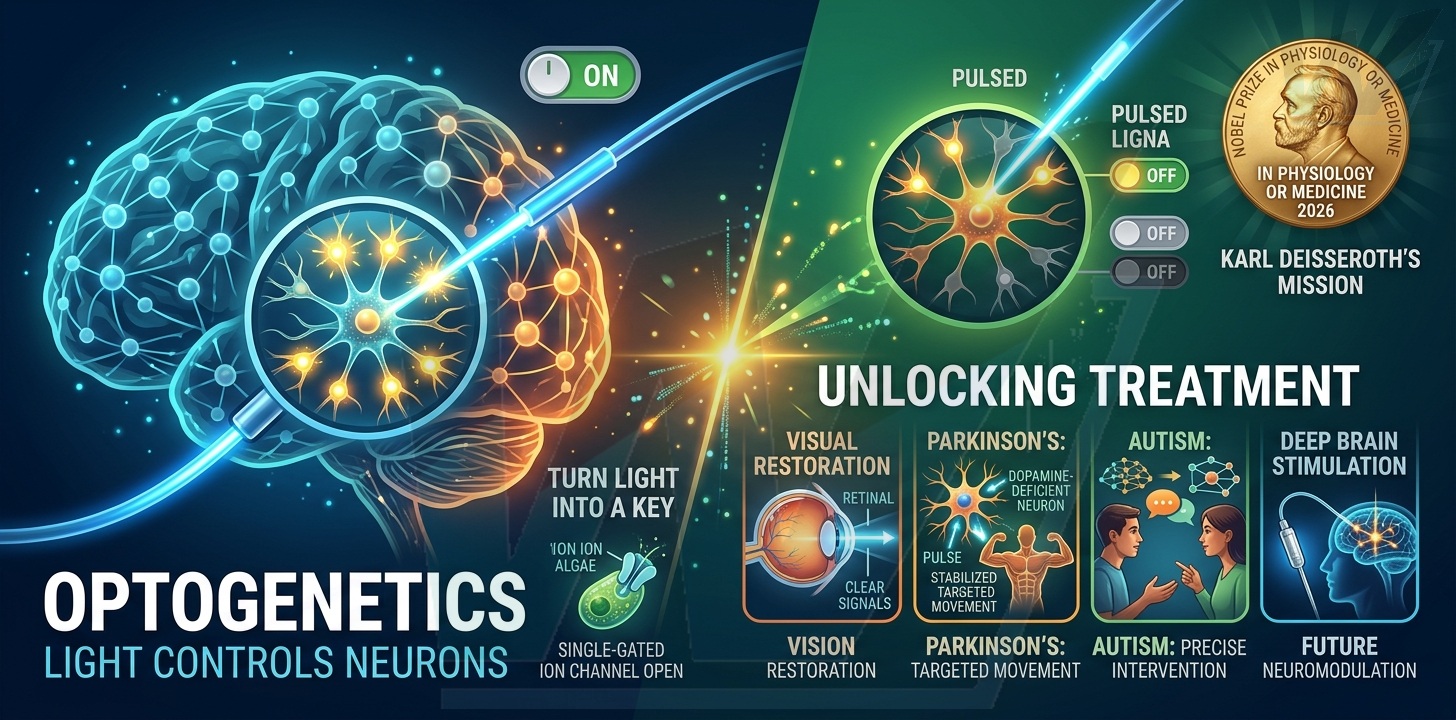
It is called optogenetic, marriage of genetics and light that allows researchers to activate or silence selected nerve cells with remarkable precision. On Monday, the discovery earned American psychiatrist, neuroscientist and bioengineer Karl Deisseroth, alongside German scientists Peter Hegemann and Georg Nagel, the 2026 Nobel Prize in Physiology or Medicine.
The Nobel Assembly honored them for discoveries involving light-gated ion channels and optogenetics, a breakthrough that has transformed neuroscience by making it possible to control individual nerve cells in a living brain.
But for Deisseroth, the prize is less than an ending than a signal that a much bigger question may finally be within reach:
Can understanding exactly which brain cells malfunction lead to better treatments for psychiatric and neurological disease?
“We needed a way to resolve them, to control one without affecting the other,” Deisseroth told AFP, explaining why light became such a powerful tool.
From algae to the human brain
The story began far from the human brain.
Hegemann and Nagel were studying single-celled algae and discovered channel rhodopsin, a light-sensitive protein that can open an ion channel when exposed to light. That discovery provided the biological machinery for making cells responsive to illumination.
Deisseroth then helped transform that discovery into a neuroscience tool.
By introducing genes encoding light-sensitive proteins into selected neurons, researchers could make those cells respond to pulses of light. Fiber-optic technology could then deliver the light, allowing scientists to switch targeted neurons on or off while observing what happened to an animal’s movement, memory or behavior.
The result was a dramatic shift in neuroscience.
Researchers no longer had to merely watch broad regions of the brain and guess which cells were responsible for behavior. They could manipulate specific circuits and ask a far more powerful question:
What happens if we turn this circuit on, or turn it off?
Nature described technology as providing a way to test cause and effect in the brain, while the Nobel Assembly said it opened a new era in neuroscience.
Psychiatry’s missing measuring stick
For Deisseroth, who is also a practicing psychiatrist and Stanford professor, the implications are especially profound for mental illness.
Psychiatry has long struggled with a fundamental problem: symptoms can be observed, but the precise biological circuits producing them are often difficult to identify.
Heart failure can be understood through measurable changes in the heart’s pumping ability. The brain is far more complicated.
Optogenetics offers a way to begin measuring dysfunction at the level of specific neural populations.
Scientists can investigate whether particular cells are excessively active, insufficiently active or improperly connected, and then use that knowledge to search for therapies that act on the relevant circuits rather than disturbing the brain more broadly. Deisseroth told AFP that this could cut through much of the guesswork that has traditionally complicated psychiatric drug development.
That possibility is one reason the Nobel breakthrough is attracting attention well beyond basic neuroscience.
From the laboratory toward treatment
Technology itself is not yet a routine treatment for psychiatric illness. But its discoveries are already influencing therapeutic development.
One striking example is vision restoration.
Researchers have used optogenetic principles to make remaining retinal cells responsive to light in people with severe vision loss caused by retinitis pigmentosa. Deisseroth pointed to this as evidence that the underlying concept can move from laboratory neuroscience toward human medicine.
The wider therapeutic ambition is even greater.
If scientists can identify the precise circuits involved in irritability, compulsive behavior, movement disorders, psychosis or other symptoms, they may eventually be able to design treatments that target those circuits more selectively.
That could matter enormously in conditions where today’s medications affect many systems simultaneously.
Autism: a search for something more precise
Deisseroth highlighted autism as an example of the therapeutic gap.
Some patients with severe irritability and aggression are treated with powerful antipsychotic medications. Those drugs can help, but they can also produce significant side effects, including sedation, weight gain and abnormal movements.
The long-term hope is to replace broad neurological intervention with something more selective treating the circuit responsible for the symptom rather than altering multiple brain systems at once.
That vision is already influencing drug-discovery programs built around optogenetic mapping of neural circuits, although researchers caution that translating discoveries from experimental models into safe, effective human treatments remains a major challenge.
Parkinson’s: treating the circuit, not the whole chemical system
Parkinson’s disease presents another powerful example.
The disorder involves the loss of dopamine-producing neurons, but dopamine operates across numerous brain functions. Replacing or increasing dopamine can therefore improve movement while affecting other systems as well.
Deisseroth’s hope is that increasingly precise knowledge of neural circuits could eventually allow medicine to influence the pathways responsible for movement without broadly stimulating every dopamine-dependent function.
That is the deeper promise of optogenetics:
Not simply more powerful treatment, but more targeted treatment.
Research groups are already using optogenetic experiments to dissect the circuitry underlying Parkinson’s and other neurological disorders, while clinicians and engineers explore how the resulting knowledge might inform technologies such as deep-brain stimulation and other neuromodulation approaches.
The brain-computer interface question
The Nobel breakthrough also points toward a future in which light could become another language between technology and the brain.
Today’s brain-computer interfaces largely rely on electrical recording and, in some systems, electrical stimulation. Optical techniques could theoretically offer another way to communicate with neural tissue.
But Deisseroth himself is cautious.
Using light to control genetically modified neurons deep inside a human brain presents formidable technical and medical challenges. Optical neurotechnology may eventually become part of the brain-computer interface landscape, but it remains a longer-term prospect rather than an established clinical technology.
That caution is important.
The Nobel Prize recognizes a transformative research method, not a finished universal treatment.
A Nobel discovery with an unfinished mission
The significance of Deisseroth’s work is therefore not that scientists have suddenly “solved” the brain.
They have not.
Instead, they have acquired something arguably more important: a sharper experimental question.
Which cells matter?
Which circuits control a particular behavior?
What happens when those cells become too active?
What happens when they fall silent?
And, ultimately, can medicine intervene at exactly that point?
The Nobel Assembly says optogenetics is now used in laboratories around the world to investigate how nerve cells shape memories, feelings and behavior.
The technique has already changed the map of neuroscience. Its next test will be whether that map can guide medicine toward treatments that are more precise, more effective and less burdensome.
For Deisseroth, that is the unfinished mission.
The scientist who helped teach light to switch neurons on and off now wants to use that knowledge to illuminate something even harder to see: