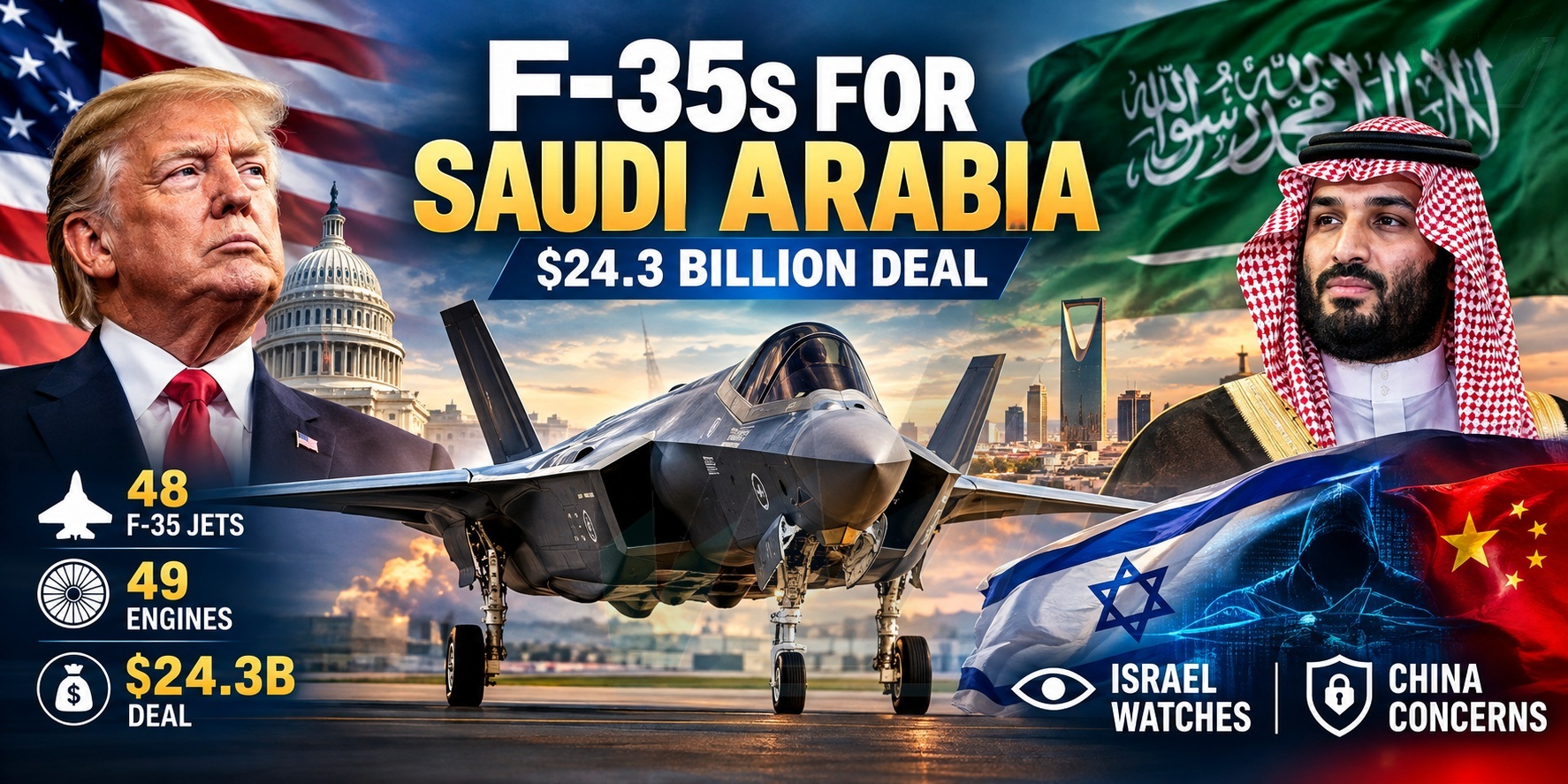
Washington approves 48 stealth fighters for Riyadh as Congress weighs the deal, Israel watches its military edge, and U.S. intelligence warns of potential Chinese access to sensitive technology
September 18, 2026
WASHINGTON — The United States has opened the door to one of the most consequential arms deals in the Middle East in years: a potential $24.3 billion sale of 48 F-35A Lightning II stealth fighters to Saudi Arabia.
The State Department formally approved the possible Foreign Military Sale on Thursday and notified Congress, setting the proposal on a path toward congressional review. The package includes 49 Pratt & Whitney F135 engines, 48 for the aircraft and one spare, plus secure communications, cryptographic equipment, electronic-warfare support, training systems, spare parts, software and long-term logistical assistance.
But the announcement is only the beginning.
If completed, Saudi Arabia would become the first Arab country to operate the F-35, and only the second Middle Eastern country after Israel to field the aircraft. The decision therefore reaches far beyond a conventional arms purchase, touching the U.S.-Saudi alliance, Israel’s military advantage, China’s growing relationship with Riyadh and the rapidly changing security map of the Gulf.
From Washington approval to a congressional test
The State Department says the proposed sale would strengthen Saudi Arabia’s homeland defense, improve its ability to deter threats and increase interoperability with U.S., regional and NATO forces.
Washington also maintains that the transaction “will not alter the military balance in the region”, reflecting the longstanding U.S. policy of preserving Israel’s qualitative military edge.
Yet the deal is not final.
Congress has been formally notified and has a statutory review period before the administration can proceed. That means the proposal could still face political and national-security scrutiny on Capitol Hill.
Even if approved, delivery would take years rather than months. The F-35 production pipeline is already extensive, meaning today’s announcement represents a strategic commitment more than an immediate change on the battlefield.
Israel’s advantage enters the spotlight
Israel remains the only Middle Eastern country currently operating the F-35, known locally as the F-35I Adir.
Israeli officials have historically been sensitive to the transfer of the aircraft to regional powers because Washington is legally committed to maintaining Israel’s qualitative military edge.
Reporting from Axios indicates that Israel did not mount the kind of strong public opposition seen in some previous cases, but Israeli officials had sought to connect the Saudi F-35 purchase with Riyadh’s potential normalization of relations with Israel. The State Department announcement did not publicly condition the aircraft sale on normalization.
That leaves a critical question for the years ahead: what configuration, safeguards and operational restrictions would accompany Saudi Arabia’s F-35 fleet?
The public notification confirms the aircraft requested by Riyadh are F-35As, but it does not publicly spell out every technical limitation or safeguard that could accompany their eventual delivery.
The China question
Behind the congressional debate lies another concern, and one that could prove especially difficult for Washington.
The New York Times reported this week that U.S. intelligence agencies have warned that China could potentially obtain sensitive F-35 technology through espionage or through its growing defense and technological relationship with Saudi Arabia. One Pentagon Defense Intelligence Agency assessment reportedly questioned whether facilities containing F-35 technology could be adequately protected.
Saudi Arabia has deepened its military relationship with Beijing, including joint exercises, while China has become an increasingly important economic and technological partner for Riyadh.
Axios reported that concerns surrounding Chinese access were a major friction point in the Saudi proposal, recalling the earlier U.S. decision to impose stringent safeguards around a proposed F-35 sale to the United Arab Emirates. That UAE deal ultimately did not materialize.
The issue is particularly sensitive because the F-35 is not simply another aircraft fighter. Its value lies in the combination of stealth, advanced sensors, information fusion, secure communications and networked warfare.
Protecting that technology is therefore central to Washington’s calculations.
Why Riyadh wants the F-35 now
Saudi Arabia has sought the aircraft for years as part of a broader effort to modernize its armed forces.
The timing is significant.
The kingdom is facing renewed attacks from Iran-backed Houthi forces in Yemen, while the wider region remains under pressure from the continuing confrontation involving Iran, Israel and the United States.
Associated Press reported this week that Saudi missile-defense resources have come under increasing pressure and that Riyadh has sought assistance from regional and Western partners as Houthi attacks threaten energy infrastructure and Red Sea shipping.
The Houthis have also expanded their presence along Yemen’s western coastline, increasing the strategic pressure around the Red Sea and Bab el-Mandeb.
Against that backdrop, the F-35 represents something different from another missile battery or upgraded fighter: a future-generation airpower capability designed to operate in heavily contested environments.
A rapidly expanding Saudi-U.S. arms relationship
The F-35 announcement is also part of a much larger military relationship.
Washington and Riyadh agreed in 2025 to a defense package valued at roughly $142 billion, according to Reuters and Saudi reporting.
The F-35 proposal now adds another major layer to that relationship.
Saudi Arabia already operates a large and diverse combat-aircraft fleet, including F-15s, Eurofighter Typhoons and Tornados. The F-35 would introduce a fifth-generation stealth platform into that force.
The kingdom has also continued purchasing other U.S. weapons and military equipment, reinforcing Washington’s role as a central supplier of Saudi defense capabilities.
Riyadh welcomes the deal
The Saudi Embassy in Washington welcomed the proposed sale, describing it as evidence of the enduring strategic relationship between the two countries.
Saudi officials said decades of security cooperation with Washington had strengthened collective defense capabilities and contributed to regional stability.
For Riyadh, the F-35 deal therefore carries both military and diplomatic significance.
For Washington, it is a test of how far the United States is prepared to deepen its defense relationship with Saudi Arabia while simultaneously protecting sensitive American technology and maintaining its commitments to Israel.
The F-35 changes the conversation before the first jet arrives
No Saudi F-35 has entered service.
No final delivery schedule has been announced.
And Congress has yet to complete its review.
But the strategic implications are already unfolding.
A completed deal would place a highly sophisticated American stealth fighter in the hands of the Arab world’s largest economy and one of Washington’s most important Gulf partners, while bringing advanced U.S. military technology closer to a country whose relations with China have expanded rapidly.
The battlefield impact may still be years away.
The geopolitical impact has already begun.
For Riyadh, the F-35 is a new shield. For Washington, it is a new strategic bet. For Israel and China, it is a development to watch closely.
And the next decision now belongs to Congress.