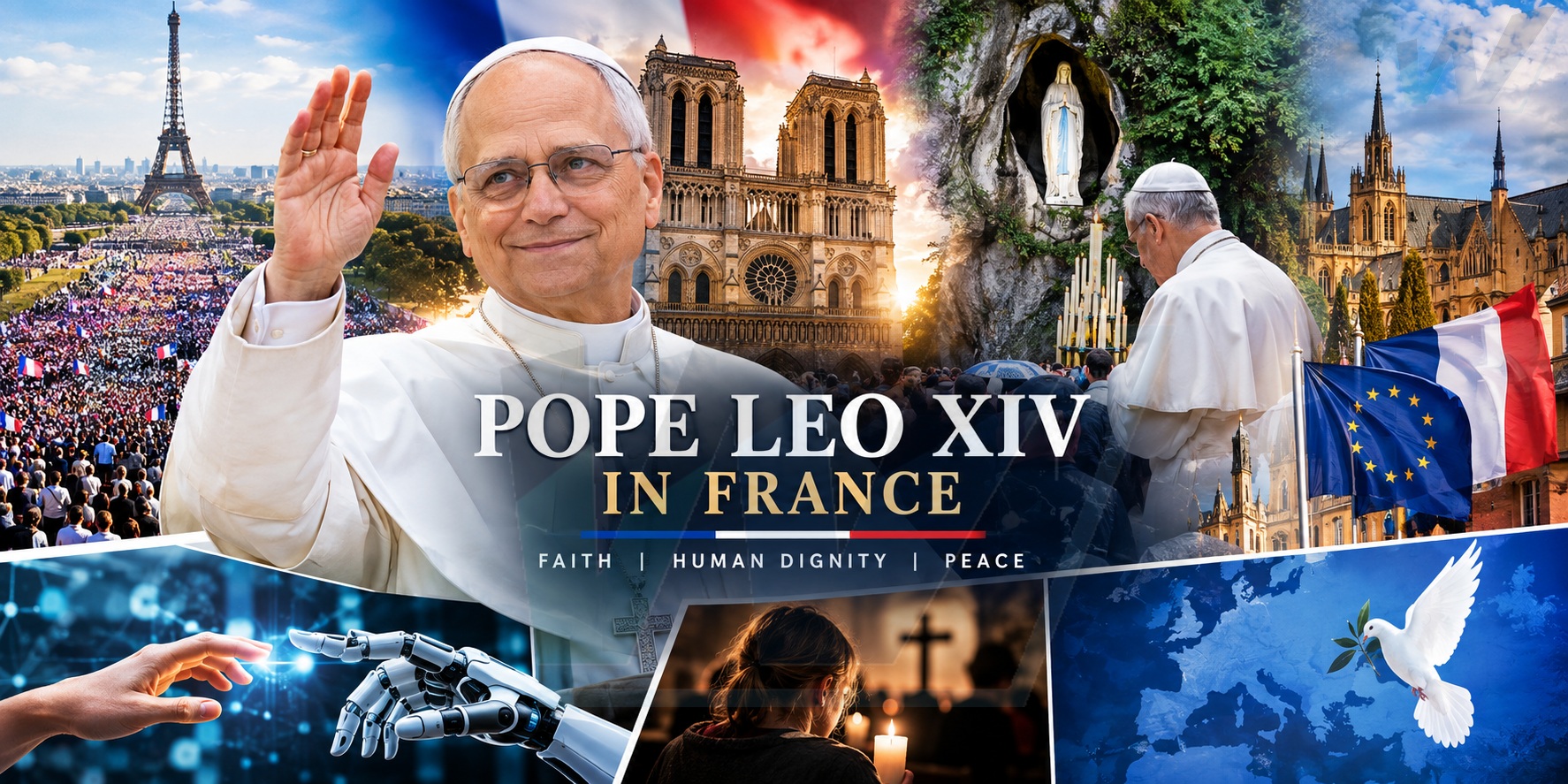
Pope Leo XIV’s France Mission Ends, But His Biggest Message Is Just Beginning
From a packed Paris to wounded Lourdes and a Europe-focused finale in Metz, Leo XIV used his first official papal visit to France to confront faith, AI, abuse, human dignity and the future of peace
September 28, 2026 / Paris–Lourdes–Metz
For four days, Pope Leo XIV moved through France—and each stop opened a different front.
In Paris, he confronted the future of humanity in an age of artificial intelligence. In Notre-Dame, he prayed at the heart of a cathedral reborn from fire. At the Stade de France, tens of thousands of young people turned a papal prayer vigil into a striking display of Catholic vitality.
Then came Lourdes.
There, beneath the shadow of France’s painful clerical-abuse history, Leo met survivors, the sick and pilgrims from around the world. His message shifted from celebration to repentance: the Church, he said, must have the courage to confront its own wounds.
And finally, in Metz, the Pope turned toward Europe itself—its Christian inheritance, its wars, its divisions and its unfinished search for peace.
The four-day journey, from September 25 to 28, was Leo XIV’s fifth international Apostolic Journey and the first official papal state visit to France since Benedict XVI’s 2008 trip. It took him through Paris, Lourdes and Metz, including a historic visit to UNESCO.
The result was a journey that was simultaneously religious, diplomatic, cultural and deeply political in the broad sense of public life—without becoming a campaign for any party or government.
Paris: The Pope walks into secular France
Leo arrived in Paris on September 25 and went directly into the French political and diplomatic arena.
At the Élysée Palace, he met President Emmanuel Macron before addressing French authorities, civil society representatives and diplomats. The Vatican said the journey was designed to explore faith, culture, society and Europe’s future.
But one subject immediately stood out: artificial intelligence.
At UNESCO, Leo warned against allowing technology to redefine humanity rather than serve it. His argument was not against technological progress itself, but against progress detached from ethical judgment and human dignity. Reuters reported that he also warned that international institutions and multilateralism were facing a profound crisis.
His warning was blunt: humanity must not drift into what he described as a technological “paradise of machines” at the expense of human judgment and moral responsibility.
The message was unmistakably broader than Catholic doctrine.
Leo was addressing a France—and a world—struggling simultaneously with war, technological disruption, political polarization and declining trust in international institutions.
Notre-Dame: Faith, memory and a cathedral reborn
Later that day, the Pope entered Notre-Dame Cathedral, the symbol of a Paris still carrying the memory of the devastating 2019 fire.
The Vatican reported that approximately 300,000 people were present along his route and around the cathedral as he arrived. Inside, Leo prayed before the Blessed Sacrament and venerated the Crown of Thorns.
The image carried its own message: a Pope entering a restored cathedral in a country where Christianity remains historically foundational but where religious practice has declined sharply.
Then Paris erupted
The following day brought the most spectacular public moment of the journey.
Crowds filled the Champs-Élysées and surrounding areas for the Pope’s open-air Mass. The Vatican estimate reported by AP and CBS was around 700,000, while other coverage placed the crowd at approximately 800,000.
The scale surprised even a country accustomed to mass public events.
Young people chanted Leo’s name. Vatican flags filled the streets. The Popemobile moved slowly through the crowds, stopping repeatedly to greet children and people with disabilities.
For French Catholic leaders, the images offered something difficult to measure through ordinary church statistics: a visible public appetite for faith.
For secular France, they posed a different question:
Has Catholicism really disappeared from French public life—or has it simply changed form?
French reporting noted the contrast between declining regular religious practice and the extraordinary response to the Pope’s visit.
The spectacle was not merely nostalgic.
It was a test of whether Catholic identity could still command a national audience in one of Europe’s most secular societies.
Lourdes: Where the celebration gave way to wounds
The mood changed dramatically in Lourdes.
At the Grotto of Massabielle, Leo prayed before the statue of the Virgin Mary, touched the rock, drank from the spring and placed a Golden Rose before Our Lady of Lourdes.
But Lourdes was also where the Church’s most painful French questions came directly into the journey.
Leo met seven survivors of clerical sexual abuse in a private encounter lasting roughly two hours, according to reporting. The meeting came against the background of France’s 2021 independent investigation into decades of abuse.
The scale of the scandal remains staggering: the investigation estimated approximately 330,000 minors were abused by clergy or others connected to the Church over roughly seven decades.
Survivors welcomed the attention but continued to demand more than symbolic gestures, including stronger institutional accountability and reforms in how allegations are handled.
Leo’s own language in Lourdes was unusually direct.
The Church, he said, must have the courage to begin with itself and recognize its “deep wounds, infidelities and painful errors.”
That became one of the defining lines of the journey.
The Pope was not simply asking France to rediscover faith.
He was telling the Church that credibility begins with confronting its failures.
Lourdes also became a battle over the meaning of compassion
The Pope’s defense of life moved into France’s fiercely contested end-of-life debate.
Leo condemned medically assisted suicide, calling it “false compassion.” His position placed the Catholic Church directly against France’s evolving legal approach to assisted dying.
The issue added another layer to the visit.
The Pope’s message about human dignity was consistent across his speeches: whether discussing AI, war, illness, migration, poverty or the end of life, the human person could not become secondary to technology, ideology, convenience or power.
Metz: The final turn toward Europe
On Monday, the Pope left Lourdes for Metz.
The choice was deliberate.
Metz is associated with Robert Schuman, one of the founding figures of European integration. The city sits close to Belgium, Luxembourg and Germany—a geographical reminder of a continent that once fought devastating wars across precisely these borders.
Here Leo’s message expanded beyond France.
He called on Europe’s religious communities to become instruments of peace and insisted that God’s name could never legitimately be invoked to justify violence or oppression.
At an interreligious meeting, representatives of Christianity, Judaism, Islam, Buddhism and other traditions gathered with him.
The Pope described dialogue as an “art of encounter” and called for the “disarmament of hearts and words.”
Then came the political heart of the final day.
A Pope asks Europe to remember where it came from
At the Robert Schuman Conference Centre, Leo urged Europe to rediscover the foundations that helped produce reconciliation after the Second World War.
Reuters reported that the Pope called on Europeans to remember the continent’s Christian history and democratic ideals while confronting today’s conflicts.
He also argued that peace negotiations require sacrifice.
As the war in Ukraine continues, Reuters reported that Leo said those seeking an end to Europe’s conflicts must be prepared to make concessions for peace.
The message placed the Pope’s journey in the wider geopolitical landscape.
From Gaza to Ukraine, from European borders to global institutions, Leo’s France visit repeatedly returned to one proposition:
Peace cannot be built simply by accumulating power. It requires dialogue, restraint and a willingness to see the dignity of the other.
Four days, one message
The geography of the journey told the story.
Paris represented culture, politics, technology and the secular public square.
Notre-Dame represented memory and Christian heritage.
The Stade de France and the Champs-Élysées revealed the continuing ability of Catholicism to mobilize enormous crowds.
Lourdes exposed the Church’s suffering, its victims and its responsibility to heal.
Metz transformed the journey into a European message about peace, unity and dialogue.
The Vatican described the journey as a mission centered on faith, culture and Europe. International media saw something broader: a Pope attempting to connect Catholic teaching with some of the defining questions of the modern age.
And France provided the perfect stage.
It is a nation deeply shaped by Christianity, yet constitutionally secular; historically attached to the Church, yet marked by declining religious practice; proud of its intellectual and political traditions, yet confronting war, technological upheaval and social fragmentation.
Leo XIV walked into that contradiction.
He did not try to erase it.
He put it on display.
And after four days—from the restored stones of Notre-Dame to the grotto of Lourdes and the European crossroads of Metz—the central question left by the journey is no longer simply whether France still has a place for the Pope.
It is whether faith, stripped of nostalgia and forced to confront its own failures, can still speak convincingly to Europe’s future.