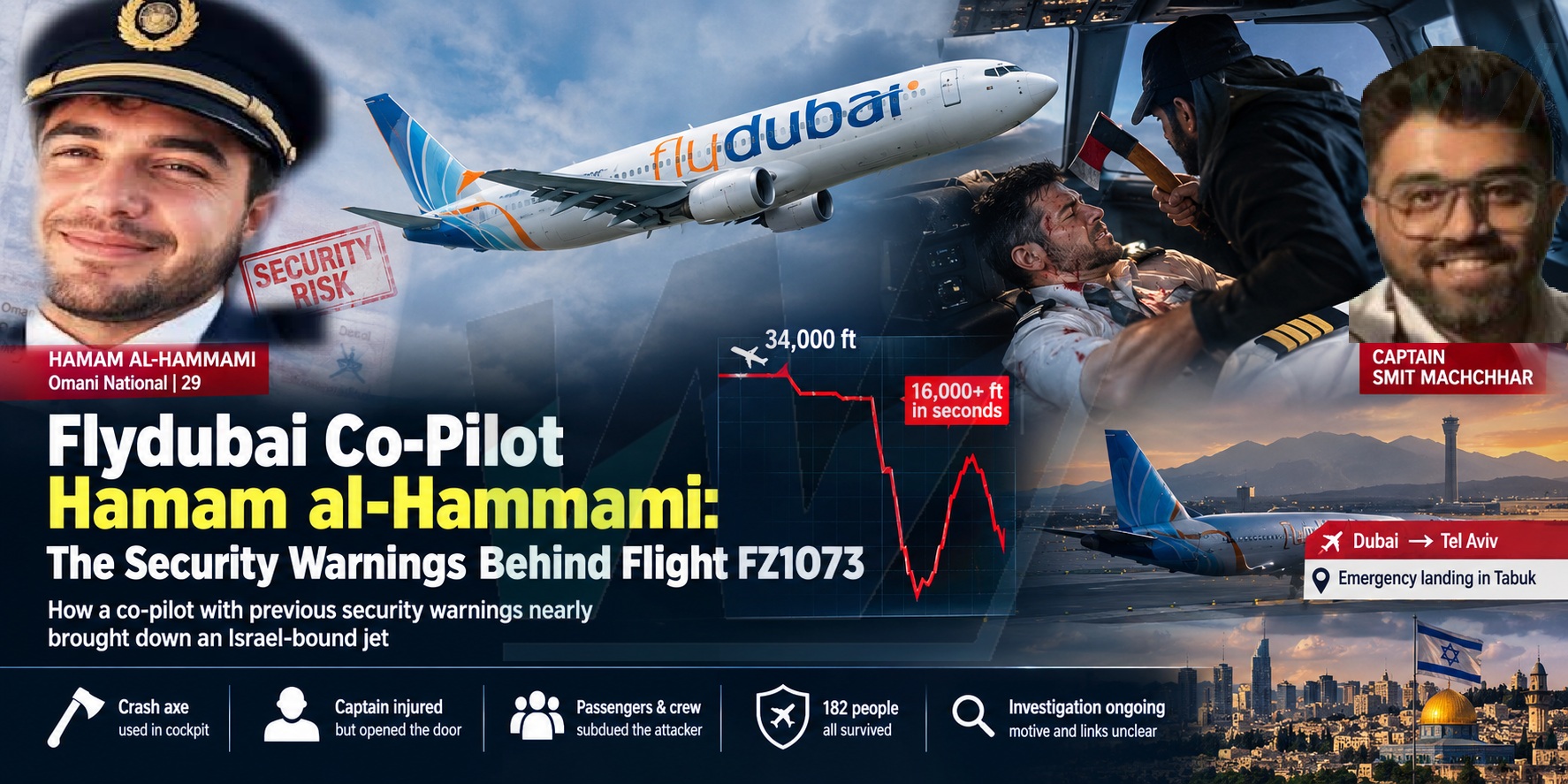
Flydubai FZ1073: How a Co-Pilot with Previous Security Warnings Nearly Brought Down an Israel-Bound Jet
How a cockpit attack sent an Israel-bound Boeing 737 into a deadly plunge, and how Captain Smit Machchhar, passengers and off-duty pilots brought it back under control
October 3, 2026, Dubai–Tel Aviv–Tabuk
A routine flight to Israel became a race against catastrophe when the co-pilot allegedly turned on his own captain, seized a cockpit crash axe and tried to take control of the aircraft.
Now, three days after Flydubai Flight FZ1073 was forced to make an emergency landing in Saudi Arabia, the investigation has produced its most serious revelation yet: UAE authorities say the co-pilot was attempting to carry out a terrorist act.
The suspect has been identified by multiple U.S., Israeli and international media outlets as 29-year-old Omani national Hamam al-Hammami — a pilot whose previous career had already raised security concerns.
According to reporting by the Wall Street Journal, Associated Press, Fox News and ABC News, al-Hammami had previously been barred from flying in Oman amid concerns about extremist views.
The question now haunting investigators is brutally simple:
How did a man reportedly flagged as a security risk end up in the cockpit of a commercial aircraft carrying 182 people toward Israel?
The flight that suddenly began to fall
Flydubai Flight FZ1073 left Dubai International Airport on September 30 bound for Ben Gurion Airport near Tel Aviv.
The Boeing 737 MAX 8 climbed normally and reached cruising altitude.
Then, roughly two and a half hours into the journey, everything changed.
The aircraft began a violent descent over the region.
Flight-tracking data showed the jet dropping more than 16,000 feet in a matter of seconds before climbing again and descending once more.
Inside the cockpit, according to the investigation, the co-pilot had attacked Captain Smit Machchhar.
The aircraft was no longer simply experiencing turbulence.
It was in a fight for survival.
The crash axe inside the cockpit
The UAE Attorney General, Hamad Saif Al Shamsi, has now provided the clearest official account yet.
Investigators found that the co-pilot attacked the captain inside the flight deck using a crash axe and then attempted to seize control of the aircraft.
The revelation solves one of the early mysteries surrounding the attack: how the assailant obtained a weapon inside the supposedly secure cockpit.
The crash axe was not smuggled through airport security.
It was emergency equipment already stored inside the flight deck.
That creates another question for aviation investigators: how should cockpit security deal with a weapon that is legally and operationally required to be there when the threat comes from a member of the flight crew?
Captain Machchhar’s last push
Machchhar was seriously injured.
But the captain did not simply collapse.
Despite his wounds, he managed to open the cockpit door.
That single action may have changed the outcome of the entire flight.
Passengers and crew members rushed toward the cockpit. The alleged attacker was overpowered and restrained.
Among those who intervened was Israeli passenger Yaniv Hayoun, who later described grabbing the controls as the aircraft was descending.
A dentist, Dr. Shota Musaev, also helped during the struggle and assisted the injured captain.
Other Flydubai pilots who happened to be travelling aboard the aircraft then helped restore control.
The chain of events was extraordinary:
A wounded captain opened the door.
Passengers entered the cockpit.
The attacker was restrained.
An ordinary passenger helped stabilize the aircraft.
Other pilots took control.
The aircraft survived.
174 passengers — 182 people aboard
Early reports varied over the number of people aboard.
Saudi authorities subsequently gave the clearest figure: 174 passengers and eight crew members — 182 people in total.
All survived.
The aircraft diverted to Tabuk, Saudi Arabia, where it landed safely.
The passengers were later transferred to another Flydubai aircraft and continued toward Israel.
The two pilots were hospitalized and subsequently transferred to the United Arab Emirates with an Emirati security team.
Who is Hamam al-Hammami?
The suspect’s identity has emerged gradually.
Multiple media organizations now identify him as Hamam al-Hammami, a 29-year-old Omani national.
His aviation history is becoming a central part of the investigation.
According to U.S. and international reporting, al-Hammami previously worked with Oman Air and was barred from flying there after concerns were raised about extremist material or views.
Sources cited by ABC News said that while working as a trainee co-pilot with Oman Air in 2024, he was found to possess extremist material.
He was reportedly subsequently permitted to remain with the airline in an administrative capacity.
Other reports have examined his education and online footprint. A profile believed to be connected to him indicated that he studied aviation management at Buckinghamshire New University in Britain.
The university confirmed that a person matching his identity completed a distance-learning aviation-management degree in 2023, while stressing that he did not receive pilot training there.
But the most important question is not where he studied.
It is how the warning signs surrounding his aviation career were handled afterward.
The security gap investigators now have to explain
The case has opened a potentially explosive aviation-security question.
If Oman had previously determined that al-Hammami should not fly because of security concerns, how did he later qualify to operate as a Flydubai co-pilot?
Investigators will have to examine:
- What information Oman possessed about him.
- Whether those concerns were formally communicated to other aviation authorities.
- What Flydubai discovered during its recruitment and vetting process.
- Whether his medical and psychological assessments raised concerns.
- Whether his previous employment history was fully checked.
- How he was cleared to operate an Israel-bound flight.
- Whether any information was missing, ignored or never shared.
The answers could have consequences well beyond Flydubai.
Radicalization, but still unanswered questions
Israeli Prime Minister Benjamin Netanyahu has said the suspect underwent Islamist radicalization and appeared determined to bring down the aircraft.
Israeli officials are also investigating whether anyone directed or assisted him.
But investigators have not publicly established a broader terrorist network.
There is currently no publicly proven Iranian connection.
President Donald Trump has warned that Iran would face a severe response if investigators established that Tehran was involved, but that remains a conditional statement — not evidence that Iran ordered the attack.
The distinction matters.
The UAE investigation is still examining motive, planning, links and digital evidence.
What investigators still need to know
The crash axe is now known.
The alleged attacker has been identified.
The aircraft’s terrifying descent has been reconstructed from flight data.
But the central mystery remains:
Why?
Investigators still need to determine:
- Whether the attack was planned.
- Whether al-Hammami acted alone.
- Whether he intended specifically to crash the aircraft in Israel.
- Whether he had contact with an extremist organization.
- Whether anyone encouraged, instructed or assisted him.
- What happened in the cockpit immediately before the descent.
- Who controlled the aircraft during each phase of the plunge.
- Why did the aircraft transmit emergency and unlawful-interference signals.
- Whether existing crew-screening procedures failed.
- Whether the suspect’s previous security history should have prevented his employment.
Flight data can show what the aircraft did.
The cockpit voice recorder, physical evidence, digital evidence, communications and witness testimony may reveal why.
Israel tightens the cockpit question
The incident has also exposed an uncomfortable contradiction in modern aviation security.
After September 11, cockpit doors were strengthened to keep attackers out.
But Flight FZ1073 presented the opposite threat:
The alleged attacker was already inside.
That changes the security equation.
A reinforced cockpit door can protect pilots from passengers.
But it can also become a barrier when the danger is one of the pilots themselves.
The case is therefore likely to fuel renewed debate over pilot vetting, continuous security monitoring, psychological assessment, cockpit procedures and emergency access protocols.
The issue is no longer simply how to keep unauthorized people out of the cockpit.
It is how to respond when the authorized person inside becomes the threat.
Flydubai suspends Israel flights
The consequences were immediate.
Flydubai suspended its operations to and from Israel while the investigation continued.
Emirates separately suspended its codeshare operations with Flydubai to and from Tel Aviv until further notice.
The disruption underlines the sensitivity of the Dubai–Israel aviation corridor, one of the most important commercial links created after the Abraham Accords.
For Israeli travelers, the incident has transformed a routine regional air route into a major aviation-security test.
The captain who refused to stay down
Captain Smit Machchhar is now recovering in Abu Dhabi.
Speaking with Indian Prime Minister Narendra Modi from his hospital bed, the veteran pilot described the moment he realized he had to get back up.
He had been badly injured.
The aircraft was falling.
And hundreds of lives depended on what happened next.
Machchhar has since been praised by Indian and Israeli leaders and by senior UAE officials.
His actions are now at the center of the story, but so are those of the passengers who moved toward the danger.
Yaniv Hayoun, Dr. Shota Musaev and others did not know exactly what was happening when they moved toward the cockpit.
They acted anyway.