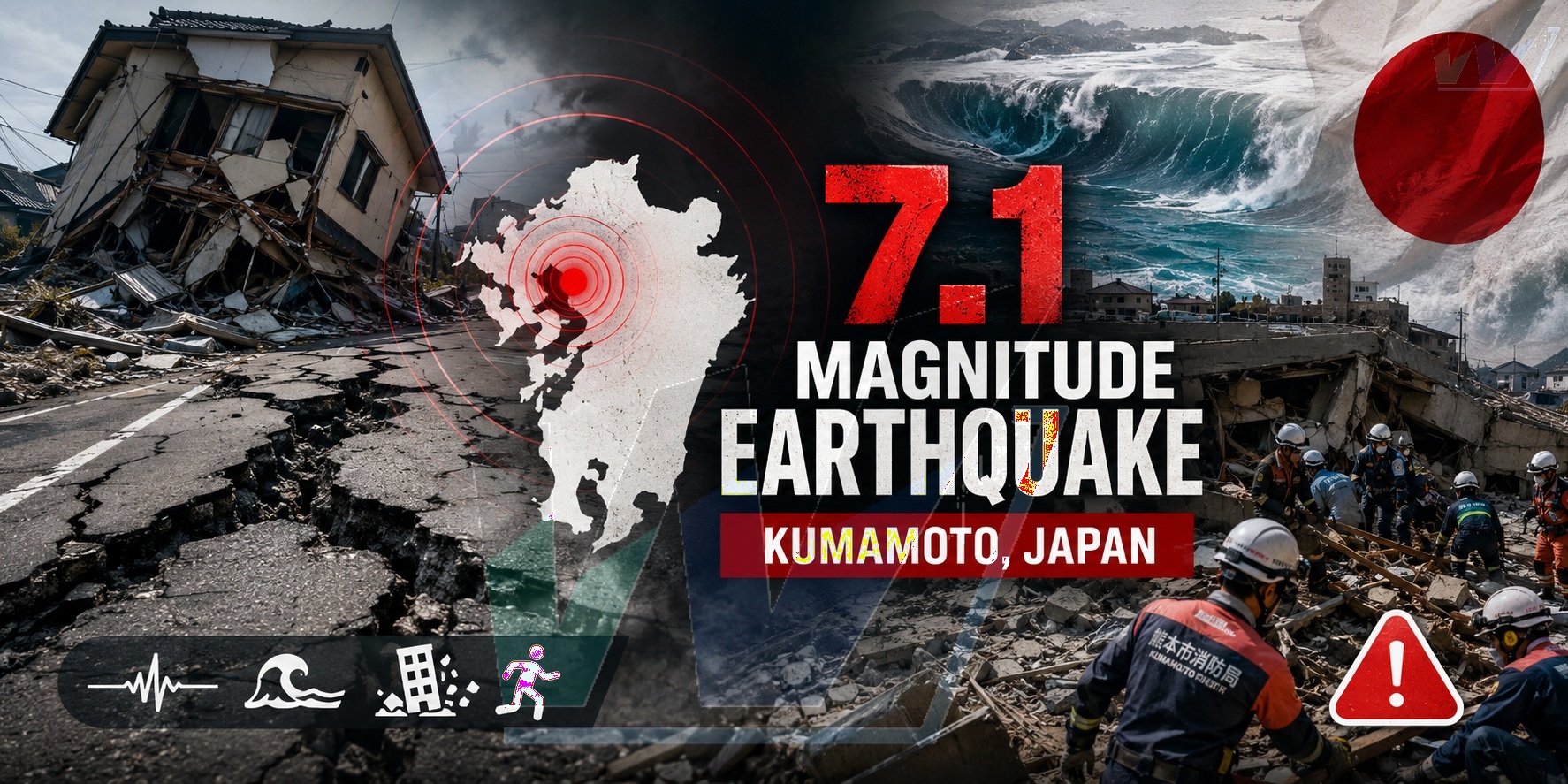
Japan Shaken by Major 7.1 Earthquake as Tsunami Alerts, Building Collapses and Mass Evacuations Follow
Japan has once again demonstrated both the destructive force of nature and the resilience of its disaster-response system after a powerful 7.1-magnitude earthquake struck Kumamoto Prefecture on the southern island of Kyushu, unleashing widespread destruction, triggering tsunami advisories, and launching one of the country’s largest emergency mobilizations in recent years.
The shallow earthquake struck during the afternoon, producing violent shaking across much of southwestern Japan. Residents described ceilings collapsing, roads splitting apart, and buildings swaying violently as emergency alerts sounded simultaneously across mobile phones, television broadcasts and public loudspeakers.
Tsunami Warning Issued for Ariake and Yatsushiro Seas
Within minutes of the earthquake, the Japan Meteorological Agency (JMA) issued tsunami advisories covering the Ariake Sea and Yatsushiro Sea, warning coastal communities to move immediately to higher ground.
Although only relatively small tsunami waves were ultimately observed and the advisory was later lifted, authorities stressed that rapid warnings are designed to protect lives because larger waves can sometimes arrive after the initial surge.
Emergency officials evacuated hundreds of thousands of residents from vulnerable coastal districts while disaster-response teams prepared for worst-case scenarios.
Rescue Teams Race Against Time
The earthquake caused severe structural damage across Kumamoto Prefecture.
Among the most dramatic incidents was the collapse and explosion at an AEON shopping mall in Kashima, where numerous workers and shoppers became trapped beneath debris.
Firefighters, police officers, Self-Defense Forces personnel, heavy rescue equipment and search dogs were rapidly deployed as rescuers searched through unstable concrete and twisted steel for survivors.
Authorities also reported:
- Multiple collapsed buildings
- Fires breaking out after the quake
- Damaged highways and local roads
- Ruptured water and gas infrastructure
- Chimney collapse at an industrial facility
- Numerous injuries requiring emergency treatment
Rescue operations continued throughout the day as aftershocks complicated efforts.
Transportation Network Severely Disrupted
The earthquake temporarily paralyzed much of Kyushu’s transportation infrastructure.
Officials suspended portions of the Shinkansen bullet train network while engineers inspected tracks, bridges and tunnels for structural damage.
Flights at Kumamoto Airport were disrupted, highways were closed for inspections, and local rail services across the region were halted until safety checks could be completed.
Logistics companies also suspended deliveries in some affected areas.
Major Manufacturers Halt Production
Japan’s manufacturing sector also felt the immediate impact.
Several major companies temporarily suspended operations, including facilities operated by:
- Toyota
- Honda
- Sony
- TSMC’s semiconductor plant in Kumamoto
The precautionary shutdowns were intended to protect workers while engineers inspected production facilities for possible structural damage.
Because Kumamoto has become a strategic center for advanced semiconductor manufacturing, analysts are closely monitoring whether the disaster could temporarily affect global electronics supply chains.
No Immediate Nuclear Emergency
Despite widespread public concern, Japanese authorities confirmed that nearby nuclear facilities reported no abnormalities following the earthquake.
Routine inspections were immediately initiated, consistent with Japan’s strict post-Fukushima safety protocols.
Officials emphasized that continuous monitoring remains underway as aftershocks continue across the region.
Hundreds of Thousands Told to Evacuate
Government agencies issued evacuation advisories affecting more than a quarter-million residents across portions of Kumamoto and neighboring prefectures.
Emergency shelters quickly opened inside schools, community centers and public buildings while local governments distributed emergency supplies and coordinated assistance for vulnerable populations.
Japan’s Self-Defense Forces were mobilized to assist with:
- Urban search-and-rescue operations
- Medical evacuations
- Damage assessments
- Emergency logistics
- Distribution of food and water
Japan’s Earthquake Preparedness Once Again Put to the Test
The latest disaster underscores Japan’s position along the Pacific Ring of Fire, one of Earth’s most seismically active regions where several tectonic plates converge.
Although Japan experiences thousands of earthquakes every year, strict building codes, sophisticated early-warning systems and regular disaster drills have dramatically reduced casualties compared with many other earthquake-prone nations.
Nevertheless, experts caution that shallow earthquakes of this magnitude can still produce devastating local damage, particularly when they occur near densely populated communities.
Echoes of the 2016 Kumamoto Earthquakes
For many residents, Tuesday’s disaster revived painful memories of the catastrophic 2016 Kumamoto earthquake sequence, which devastated large portions of the prefecture, claimed dozens of lives and damaged historic landmarks including Kumamoto Castle.
Authorities are closely inspecting structures that had already undergone repairs following the earlier disaster to ensure they remain safe after the latest powerful shaking.
Aftershocks Expected
The Japan Meteorological Agency warned that significant aftershocks could continue for several days, increasing the risk of additional building collapses and landslides, particularly in mountainous terrain saturated by seasonal rains.
Residents have been urged to:
- Stay away from damaged buildings.
- Prepare emergency supplies.
- Monitor official government updates.
Remain alert for additional strong shaking.