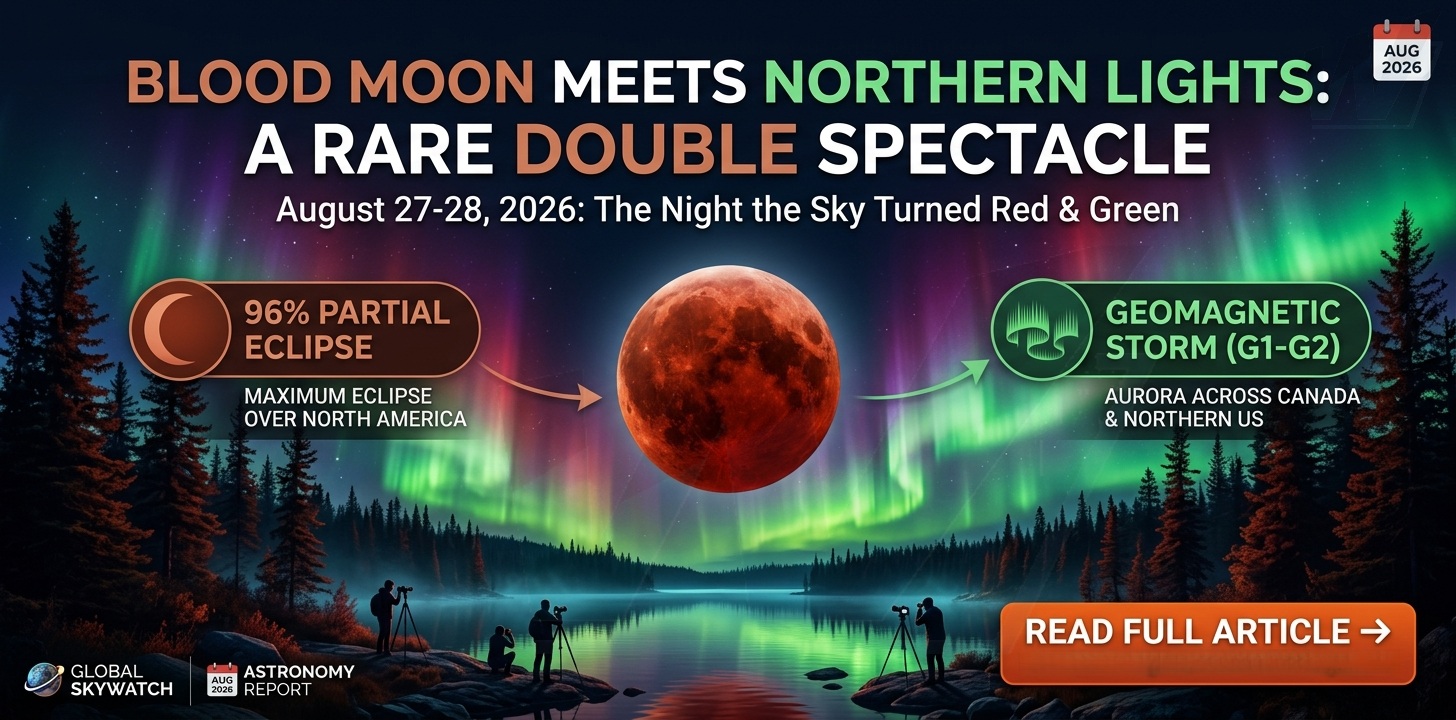
The Blood Moon and Northern Lights Shared the Sky
A deep partial lunar eclipse turned almost the entire Moon copper red as a geomagnetic storm opened the door for auroras across parts of North America and Canada.
WASHINGTON — August 28, 2026; For a few extraordinary hours, the night sky offered two spectacles at once.
The Moon slipped deep into Earth’s shadow, turning a brilliant full moon into a dark copper-red “Blood Moon”, while heightened solar activity raised the possibility of Northern Lights dancing across skies far farther south than usual.
It was a rare celestial coincidence unfolding overnight on August 27–28.
When the Moon Turned Red
The event was a deep partial lunar eclipse, with approximately 96% of the Moon’s disk entering Earth’s darkest shadow, according to astronomical and weather reports.
At maximum eclipse, only a thin portion of the lunar surface remained outside the umbra.
The Moon did not disappear completely.
Instead, it took on a dramatic red-orange or copper hue.
The effect is produced when sunlight passes through Earth’s atmosphere. Blue wavelengths are scattered more strongly, while red and orange light is refracted toward the Moon, creating the familiar “Blood Moon” appearance.
Unlike a solar eclipse, no special eye protection was required to watch the lunar event.
And Then Came the Aurora
The Moon was not the only attraction.
A stream of solar particles heading toward Earth raised the possibility of a G1–G2 geomagnetic storm, according to space-weather forecasts.
That opened the possibility of Northern Lights appearing across parts of Canada and the northern United States, potentially reaching considerably farther south than during an ordinary auroral display.
For observers in parts of Canada, the conditions were particularly promising.
Locations from western and central Canada to parts of Ontario and the northern United States were among the areas watching the forecasts closely.
The possibility was extraordinary:
A red Moon overhead, and green, red or violet auroras on the horizon.
Why the Two Events Coincided
The eclipse and aurora were not physically connected.
They simply arrived at the same time.
The lunar eclipse was caused by the alignment of the Sun, Earth and Moon, with Earth passing between the two and casting its shadow across the lunar surface.
The aurora, meanwhile, was driven by activity on the Sun.
When energetic solar particles interact with Earth’s magnetic field and upper atmosphere, they can produce the shimmering curtains of light known as the aurora borealis.
This week, space-weather forecasters were monitoring a possible coronal mass ejection and fast solar-wind streams capable of strengthening geomagnetic activity.
A Celestial Show Across Continents
The eclipse was visible across much of North and South America, with portions of Europe and Africa also able to see parts of the event depending on local timing and the Moon’s position.
For observers across the Americas, the spectacle was particularly favorable.
At its peak, roughly 96% of the Moon was immersed in Earth’s umbra, making this one of the deepest partial lunar eclipses visible from the region in years.
For many skywatchers, the darkness created another advantage:
Less moonlight meant darker skies around the eclipse, potentially making stars and auroras easier to notice.
The Night Sky Became the Story
Astronomers and astrophotographers prepared for a rare photographic opportunity.
A tripod, a clear view of the horizon and a dark location away from city lights offered the best chance of capturing both phenomena.
Smartphones could also record the aurora, although cameras often reveal colors that are difficult to see with the naked eye.
But photographs were only part of the experience.
For those beneath a clear sky, the real spectacle was happening overhead:
The Moon turning red while the atmosphere around it potentially came alive with auroral light.
What Made This Night Special?
A lunar eclipse is not exceptionally rare.
Auroras are not exceptionally rare either.
But seeing the two at the same time, from the same location, is a much more unusual opportunity.
And that is what made the night of August 27–28 so compelling for skywatchers.
The Moon was moving through Earth’s shadow.
The Sun was sending a storm of particles toward our planet.
And millions of people were looking upward.
One night. Two worlds.
A Blood Moon from Earth’s shadow.
Northern Lights from the Sun.
For a few hours, the sky became a reminder that Earth is not an isolated world , but a planet constantly interacting with the space around it.
A Red Moon. A Solar Storm. One Extraordinary Night.