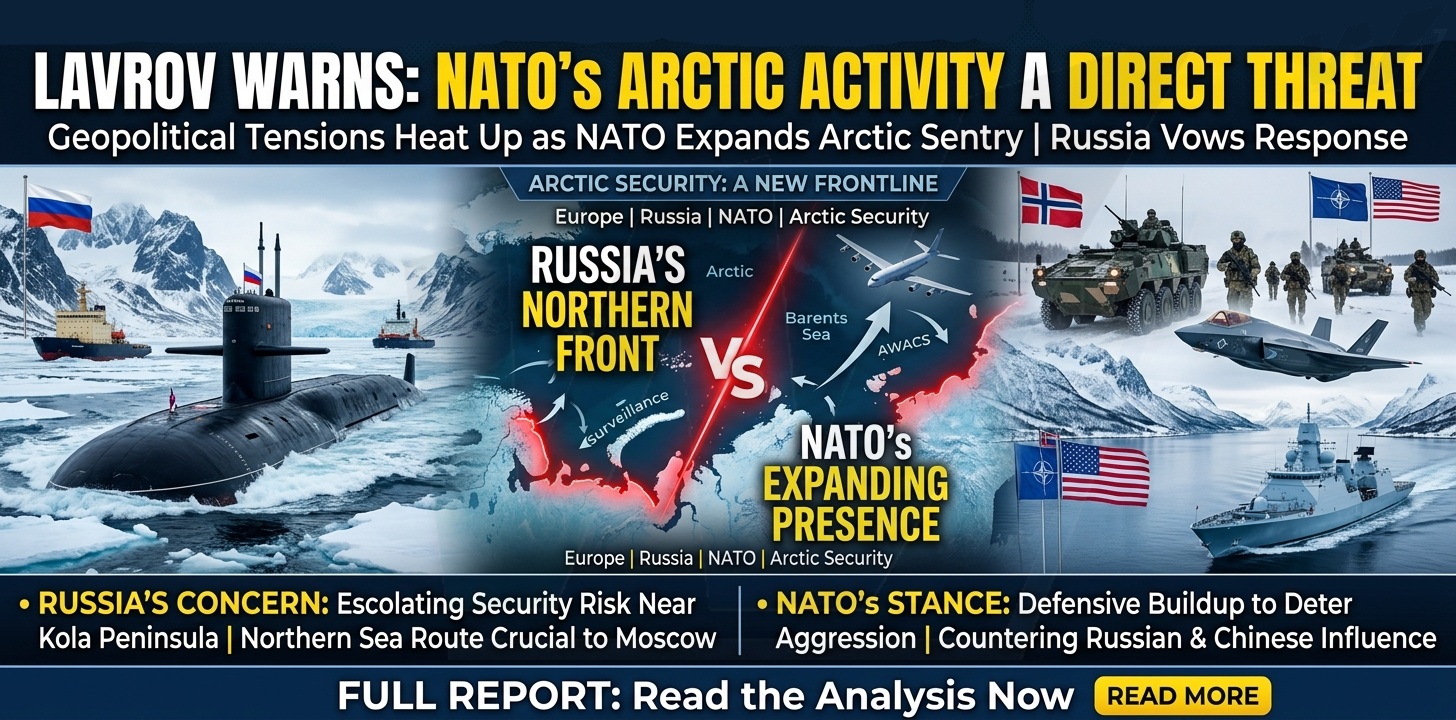
The Arctic Is Heating Up: Lavrov Warns NATO’s New Military Push Could Trigger a Catastrophic Clash
Europe / Arctic Security / NATO / Russia / Greenland
Russia has accused NATO of turning the Arctic into a new military flashpoint, with Foreign Minister Sergei Lavrov warning that the alliance’s expanding presence poses a “direct threat” to Moscow and could increase the risk of a dangerous confrontation.
The warning comes as NATO expands Arctic Sentry, a security initiative launched in February 2026 to strengthen surveillance, deterrence and defense across the High North.
For Moscow, the message is clear: NATO is moving deeper into a region Russia considers vital to its national security.
NATO Expands Its Arctic Presence
NATO says its Arctic buildup is a defensive response to Russia’s military expansion and China’s growing strategic interest in the region.
The shift is already visible.
More than 32,000 troops from 14 NATO allies participated in Cold Response 2026 across northern Norway and Finland, conducting land, sea, air, cyber and space operations.
NATO has also increased Arctic surveillance, including AWACS flights over the Barents Sea involving Canada, the Netherlands, Norway and the United States.
Moscow sees the growing concentration of forces, aircraft and surveillance assets near Russia’s northern approaches as an escalating security risk.
Russia Still Holds a Major Arctic Advantage
Russia remains the dominant military power in the Arctic, with strategic submarines, military bases, airfields, radar systems and a large icebreaker fleet.
The Kola Peninsula, home to key elements of Russia’s nuclear deterrent, makes the region particularly sensitive.
At the same time, Moscow is expanding the Northern Sea Route, the Arctic shipping corridor linking Russia’s northern coast with the Pacific.
Reuters reported that roughly 6 million barrels of Russian crude had already moved to Asia through the route in 2026, highlighting its growing economic and strategic importance.
More shipping means more infrastructure, and potentially more military competition.
China and Greenland Raise the Stakes
Russia is also deepening Arctic cooperation with China and India, while Beijing continues to pursue Arctic energy, minerals, shipping and scientific interests.
That is transforming the High North into a wider geopolitical contest involving Russia, NATO, China and the United States.
At the center sits Greenland.
President Donald Trump’s renewed push for greater U.S. control of the strategically located island has added another layer of tension inside the Western alliance, since Greenland belongs to NATO member Denmark.
For NATO, Greenland, the North Atlantic and the Arctic are increasingly interconnected parts of the same strategic security zone.
Melting Ice Is Changing the Equation
The Arctic itself is changing.
NASA and the National Snow and Ice Data Center reported that the 2026 Arctic winter sea-ice maximum reached about 14.29 million square kilometers, statistically tied with 2025 for the lowest maximum in the satellite record and roughly 1.36 million square kilometers below the 1981–2010 average.
Thinner and retreating ice is making parts of the Arctic more accessible to shipping, military operations and resource development.
The result is a paradox:
The ice is disappearing, but the strategic competition is intensifying.
The Biggest Risk: Miscalculation
Lavrov’s warning is ultimately about more than an intentional attack.
It is about miscalculations.
More aircraft. More submarines. More naval patrols. More surveillance. More exercises. More commercial traffic.
As NATO and Russian forces operate increasingly close to one another, the possibility of an accident or misunderstanding grows.
NATO, meanwhile, says it does not currently see an imminent Russian attack, even as it strengthens its northern defenses.
The Arctic Has Become a New Frontline
Russia wants to protect its Arctic military position and control of the Northern Sea Route.
China wants greater access to Arctic resources and shipping.
NATO wants to secure its northern flank and prevent strategic dominance by Moscow or Beijing.
The United States sees Greenland and the High North as increasingly critical to its security.
And a changing climate is making the region more accessible to everyone.
For decades, the Arctic was a natural barrier. Now it is becoming a strategic battlefield.
The next crisis may not begin with a missile.
It could begin with a radar contact, a patrol aircraft, a submarine or a commercial vessel, in a region where the line between deterrence and escalation is getting thinner.