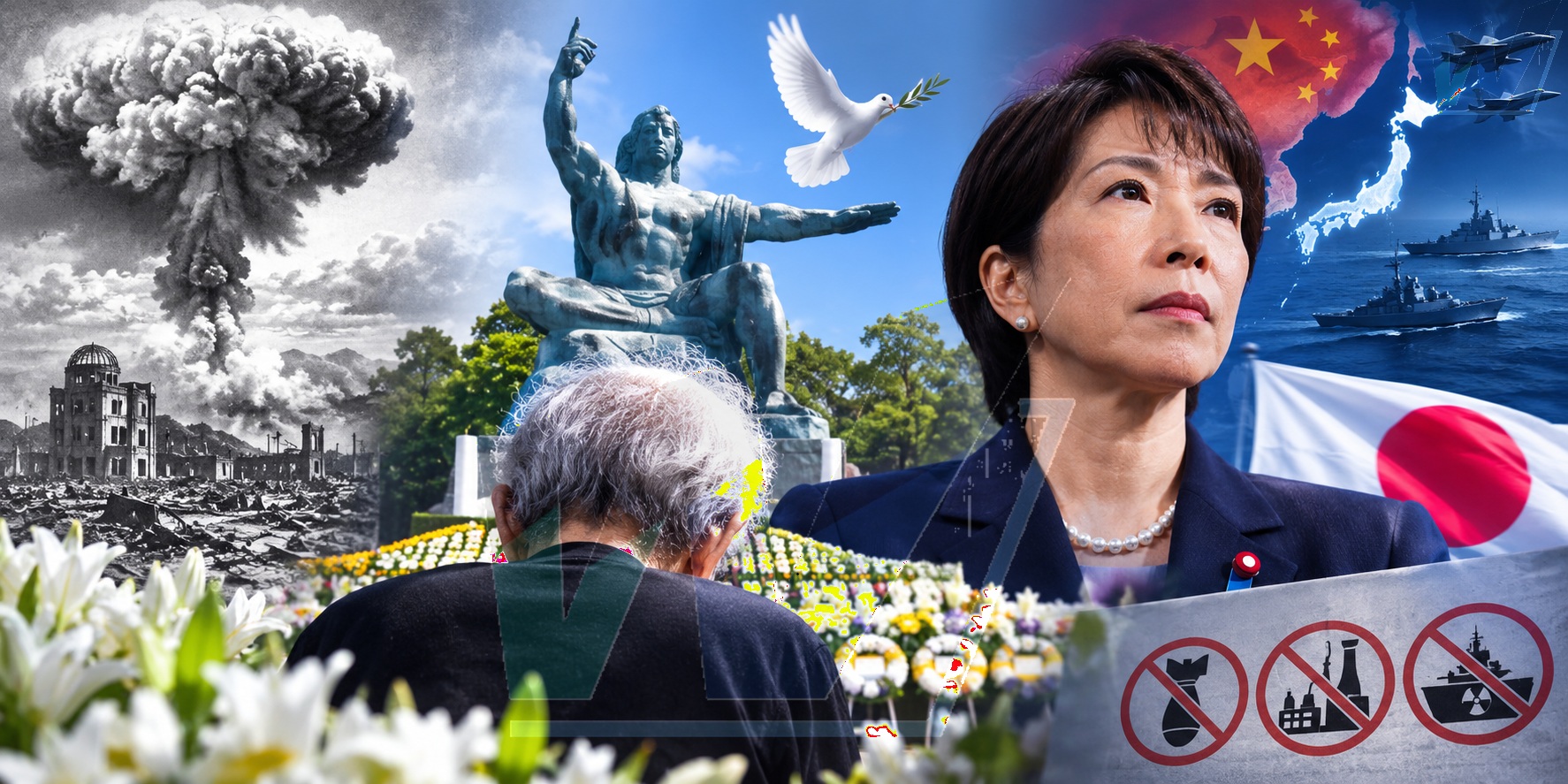
Nagasaki marks 81 years since the atomic bombing as Japan’s nuclear debate intensifies. PM Sanae Takaichi faces pressure over the country’s non-nuclear principles, U.S. nuclear umbrella and rising threats from China and North Korea.
At 11:02 a.m., Nagasaki fell silent. But beyond the memorial ceremony, a far more uncomfortable question is now shaking Japan: Can the country that suffered the world’s only wartime atomic attacks continue to rely on a nuclear umbrella without eventually reconsidering its own nuclear taboo?
NAGASAKI, Japan — August 9, 2026
At precisely 11:02 a.m., the bells rang across Nagasaki.
For a moment, the city stopped.
At the Peace Park, representatives from more than 90 countries gathered to remember the tens of thousands who died when a U.S. B-29 bomber dropped an atomic bomb on the city on August 9, 1945.
The bomb, known as “Fat Man,” transformed Nagasaki in seconds.
By the end of 1945, about 70,000 people had died.
Eighty-one years later, the city was again asking the world to remember what happened.
But this year, there was another question hanging over the ceremony — one that reaches directly into the heart of Japan’s national security strategy.
Could Japan’s decades-old nuclear restraint be changing?
A warning from Nagasaki
Nagasaki Mayor Shiro Suzuki delivered an unusually forceful warning against the growing international reliance on nuclear deterrence.
He described nuclear weapons as “absolute evil” and argued that the doctrine of nuclear deterrence is neither stable nor safe.
His message was directed not only at the world’s nuclear powers, but also at governments that rely on nuclear weapons belonging to their allies.
The warning carried particular weight because Japan itself stands at the center of that contradiction.
Japan does not possess nuclear weapons.
Yet its security strategy depends in part on the U.S. nuclear umbrella.
Suzuki urged Tokyo to preserve Japan’s three postwar non-nuclear principles and to participate in international efforts aimed at banning nuclear weapons.
The principles are straightforward:
-
Do not possess nuclear weapons.
-
Do not produce nuclear weapons.
-
Do not allow nuclear weapons to be introduced into Japan.
Japan’s Defense Ministry continues to officially describe these three principles as a fundamental element of national policy.
But the political debate surrounding them is becoming increasingly difficult to contain.
Takaichi’s carefully chosen words
Prime Minister Sanae Takaichi attended Sunday’s Nagasaki ceremony.
Her position is politically delicate.
Takaichi has repeatedly spoken in favor of a world without nuclear weapons and has said Japan currently maintains its three non-nuclear principles.
But she has also avoided closing the door on a broader discussion about the country’s nuclear deterrence arrangements.
That distinction matters.
Japan’s first two principles, not possessing and not producing nuclear weapons, are comparatively clear.
The third, not allowing nuclear weapons to be brought into Japan, is far more politically sensitive because of the country’s military alliance with Washington.
Japan relies on U.S. extended deterrence, including America’s nuclear capabilities, while simultaneously maintaining its identity as the world’s only country to have suffered atomic attacks in wartime.
That tension has existed for decades.
In 2026, however, it is becoming impossible to ignore.
The taboo is cracking
The debate accelerated dramatically after Defense Minister Shinjiro Koizumi argued that Japan could no longer treat nuclear deterrence as a subject that was simply off limits.
His call for a discussion “without taboos” triggered an immediate backlash from Hiroshima and Nagasaki survivor organizations.
European reporting has highlighted the growing divide between Japan’s historic anti-nuclear identity and the country’s rapidly changing security environment. Le Monde reported that a Kyodo survey found 76% of Japanese respondents opposed changing the three non-nuclear principles.
That resistance is significant.
For decades, the memories of Hiroshima and Nagasaki helped form one of the strongest anti-nuclear political cultures in the world.
But the security environment surrounding Japan has changed dramatically.
China is expanding its military and nuclear capabilities.
North Korea continues to develop nuclear weapons and increasingly sophisticated missile systems.
Russia’s war in Ukraine has revived fears about nuclear coercion and deterrence.
And doubts about the long-term reliability of America’s security commitments have added another layer of uncertainty.
The result is a question that once seemed politically unthinkable:
If Japan’s enemies possess nuclear weapons, should Japan continue relying entirely on another country’s nuclear deterrent?
China is watching
The nuclear debate cannot be separated from Japan’s rapidly changing military posture.
Tokyo’s latest defense strategy identifies China as its most serious strategic concern.
Japan’s 2026 defense white paper describes growing Chinese military activity, particularly around Taiwan and the East China Sea. Reuters reported that Tokyo is preparing further changes to its national security strategy, including stronger capabilities involving long-range missiles and unmanned systems.
China has reacted angrily.
Beijing formally complained about Japan’s latest defense white paper, accusing Tokyo of exaggerating the Chinese threat and interfering in Taiwan-related affairs. China also warned against what it characterized as a revival of Japanese militarism.
The timing could hardly be more sensitive.
Japan is simultaneously strengthening its conventional military capabilities while debating the credibility of nuclear deterrence.
That combination has alarmed neighboring countries.
Japan’s military transformation is already underway
The nuclear question is only one piece of a much larger transformation.
Japan has been steadily moving away from the highly restrained security posture that characterized much of the postwar era.
Its defense spending has risen to around 2% of GDP, while Tokyo has loosened restrictions surrounding weapons exports and expanded cooperation with countries across the Indo-Pacific.
Japan’s 2026 defense white paper also emphasizes artificial intelligence, combat drones, missiles and unmanned systems as critical technologies for future warfare. AP reported that Tokyo increasingly views uncrewed systems as a way to compensate for both rapidly changing warfare and demographic pressures.
Reuters described the transformation as the country’s largest military expansion since World War II.
The strategic message is clear:
Japan is preparing for a much more dangerous Asia.
But the nuclear question remains the red line.
The survivors are disappearing
Perhaps the most painful element of the debate is time.
The hibakusha, survivors of Hiroshima and Nagasaki, are growing older.
Their average age is now above 86, according to recent reports, while the number of officially recognized survivors has fallen sharply over the past decade.
Every year, fewer people remain who can personally describe what happened in 1945.
That makes the annual ceremonies more than historical commemorations.
They are becoming a race against time.
For survivors, the argument is not theoretical.
It is not a question of missile ranges, strategic doctrines or nuclear umbrellas.
It is a memory of what happens when the theory of deterrence becomes an actual explosion over a populated city.
A world becoming less certain about nuclear restraint
The Nagasaki ceremony comes against a troubling international backdrop.
The 2026 Nuclear Non-Proliferation Treaty Review Conference ended without agreement on a consensus final document, marking another failure by the international community to reach common ground on nuclear disarmament and non-proliferation.
That failure matters enormously to Japan.
Tokyo has traditionally portrayed itself as a bridge between nuclear-armed states and countries demanding nuclear disarmament.
But the international environment is moving in the opposite direction.
Nuclear deterrence is being discussed more openly.
Military alliances are being reassessed.
Nuclear arsenals are expanding.
And wars in Europe and the Middle East have demonstrated how quickly strategic calculations can change.
For Japan, the dilemma is therefore becoming sharper:
How do you campaign for a world without nuclear weapons while depending on nuclear deterrence for your own survival?
A country caught between memory and fear
This is the contradiction at the heart of Japan’s 2026 nuclear debate.
One side is represented by Nagasaki.
It says that nuclear weapons are fundamentally incompatible with humanity and that relying on them increases, rather than eliminates, the risk of catastrophe.
The other side points toward the map.
China.
North Korea.
Russia.
Taiwan.
And the uncertain future of the U.S.-Japan alliance.
Japan’s government is attempting to occupy the narrow space between those two realities.
Takaichi has not announced a Japanese nuclear weapons program.
Nor has Tokyo formally abandoned the three non-nuclear principles.
Indeed, Japan’s government has continued to publicly affirm them. In July, Chief Cabinet Secretary Minoru Kihara said the government remained committed to the three principles while also emphasizing the importance of strengthening the credibility of U.S. extended deterrence.
But the fact that the subject is now being debated openly represents a profound change in itself.
The nuclear threshold
Japan is also an unusual case because it possesses advanced civilian nuclear technology and a sophisticated industrial and scientific base.
That has led analysts to describe Japan as a “threshold” nuclear state, a country without nuclear weapons but possessing substantial technological capabilities relevant to a potential weapons program.
That does not mean Japan is preparing to build a bomb.
It means the strategic debate surrounding Japan is fundamentally different from that surrounding most non-nuclear countries.
Tokyo already possesses much of the industrial, scientific and technological infrastructure associated with advanced nuclear capability.
The political decision remains the barrier.
And that barrier is precisely what today’s debate is testing.
The clock is ticking
At Nagasaki’s Peace Park, the ceremony ended.
Flowers were placed.
Prayers were offered.
Names were remembered.
And the bells eventually fell silent.
But the political argument will not.
Japan is entering a pivotal period as its government prepares revisions to its major national security documents later this year.
Those revisions could determine how far Tokyo moves toward a more assertive military posture, and whether the three non-nuclear principles remain completely untouched.
For the hibakusha, there is an urgency that politics cannot postpone.
Their numbers are shrinking.
Their memories are fading from living testimony into history.
And yet the weapons they spent their lives warning about have not disappeared.
Quite the opposite.
The world is once again discussing them as instruments of national survival.
That is why Nagasaki’s message on its 81st anniversary was so stark.
The city was not merely remembering the past.
It was warning about the future.
At 11:02 a.m., Nagasaki remembered what one bomb did to a city.
The question now confronting Japan is whether that memory will remain powerful enough to shape the country’s next nuclear decision.