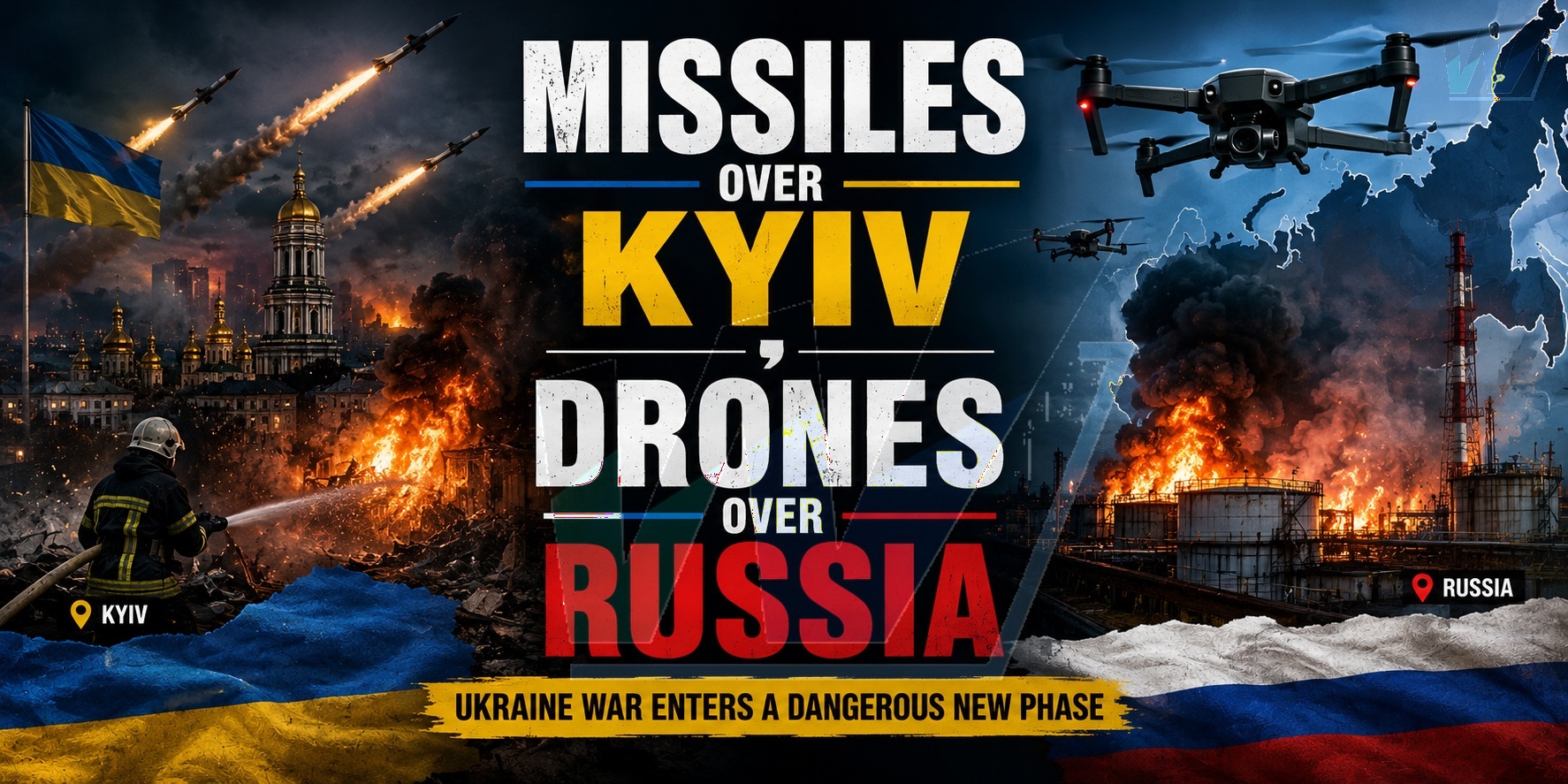
Ukraine War: Russian Missiles Smash Kyiv and Zaporizhzhia as Trump-Putin Diplomacy Fades
Deadly strikes, deep Ukrainian drone attacks and allegations of torture expose a war accelerating in both directions, just as hopes for a negotiated peace begin to disappear.
KYIV — The warning came first.
Then the explosions.
Before dawn on Tuesday, Russian ballistic missiles tore into the skies over Kyiv as air-raid sirens sent residents scrambling for shelter. Blasts shook the Ukrainian capital; fires erupted in a central district and emergency crews rushed toward damaged buildings.
Thousands of kilometers away from the front line, another Russian attack was unfolding in Zaporizhzhia.
This time, the death toll was even higher.
Five people were killed and 20 wounded after Russian forces struck the southeastern Ukrainian city with missiles and aerial bombs, according to regional authorities. In Kyiv, at least one person was reported injured as fires broke out in a central district. Reuters reporters said they heard explosions in the capital.
The attacks delivered a brutal message:
Whatever diplomatic hopes once surrounded the Russia-Ukraine war, the battlefield is still speaking louder.
And it is speaking with missiles.
Kyiv Under Ballistic Attack
The first explosions came shortly after midnight.
Kyiv Mayor Vitali Klitschko warned that the capital was under a ballistic-missile attack as air-raid sirens echoed through the city.
Emergency services were dispatched to the Shevchenkivskyi district, where fires were reported and warehouses were damaged.
The attack lasted roughly 40 minutes before the all-clear was announced, according to the report supplied in the live updates.
The scene was familiar to Ukrainians after more than four years of full-scale war: the sudden darkness of a city under air-raid alerts, the sound of incoming weapons, then emergency vehicles racing through streets illuminated by flames.
But the location mattered.
Kyiv remains one of Moscow’s most politically charged targets.
Every strike on the capital carries a message beyond its immediate military effect.
It is a demonstration of reach.
A warning.
And, potentially, an attempt to influence the political calculations taking place far from the battlefield.
Russia has increasingly relied on ballistic missiles as part of its long-range strike campaign. Ukrainian President Volodymyr Zelenskyy has repeatedly warned that Moscow is stockpiling missiles and using ballistic weapons to sustain pressure on the country.
Zaporizhzhia Pays the Heavier Price
While Kyiv endured another night of explosions, Zaporizhzhia suffered the deadliest confirmed toll of the latest barrage.
Five people were killed and 20 injured after Russian forces struck industrial facilities and infrastructure, according to regional governor Ivan Fedorov.
Buildings and vehicles were damaged, while emergency teams worked through the aftermath.
The toll underlined a recurring reality of the war: Russian attacks are not confined to the immediate front.
Cities hundreds of kilometers from active trenches remain exposed to missiles, drones and guided bombs.
And the pressure is becoming increasingly difficult to separate from the broader struggle over Ukraine’s industrial and economic infrastructure.
The latest strike came amid a wider campaign in which Russia has repeatedly targeted Ukrainian energy, transport, industrial and civilian infrastructure.
British officials have previously warned that Russia’s intensified aerial attacks are increasing the danger of wider escalation across Europe. The UK told the OSCE in July that Russian missile and drone attacks were putting civilians at risk and increasing the possibility of miscalculation beyond Ukraine’s borders.
Then the War Crossed Back into Russia
But the night did not belong entirely to Russian missiles.
Ukraine has increasingly demonstrated that it can strike deep inside Russian territory.
In the Voronezh region, a drone attack killed one person and injured two others, according to regional governor Alexander Gusev.
Russian air defenses said they destroyed 15 drones over Voronezh and five districts of the region.
Falling debris caused fires at two warehouses belonging to a large company. One fire covered approximately 16,000 square meters, while another spread across roughly 20,000 square meters, according to the governor.
The company was not identified.
Russian online retailer Wildberries said its logistics facilities in the region had been evacuated as a safety precaution.
The attacks form part of a rapidly expanding Ukrainian strategy: take the war deep into Russia’s economic and industrial rear.
That strategy has become increasingly visible.
On Monday, Ukraine confirmed a strike on the Taneco oil refinery in Russia’s Tatarstan region. The attack killed at least 13 people and wounded dozens, according to reports, in one of the deadliest Ukrainian strikes on Russian territory since the full-scale invasion began.
For Kyiv, the objective is increasingly clear.
If Russia can bombard Ukrainian cities and infrastructure, Ukraine wants Moscow to discover that its own industrial heartland is not beyond reach.
The Drone War Is Becoming a War of Distance
The geography of the conflict is changing.
The frontline still matters.
But increasingly, the decisive question is not simply who controls which village.
It is:
Who can strike deeper?
Ukraine’s long-range drone campaign is forcing Russia to defend infrastructure hundreds of kilometers from the front.
Oil refineries.
Military facilities.
Warehouses.
Transport hubs.
Industrial plants.
The strategy seeks to impose economic and logistical costs while forcing Moscow to spread its air-defense network across a much larger territory.
Russia, meanwhile, continues to use drones and missiles to attack Ukrainian cities and infrastructure.
The result is a war increasingly defined by distance.
The front line may be hundreds of kilometers away, but the war can arrive at any doorstep.
A New Shadow Over the Battlefield: North Korea
And then there is North Korea.
Ukrainian officials have warned that Russia could receive a new wave of North Korean troops, with President Volodymyr Zelenskyy claiming that as many as 30,000 to 50,000 North Korean soldiers could be deployed.
That figure should be treated as a Ukrainian estimate or warning, not as an independently confirmed troop deployment.
But the underlying military relationship is not new.
North Korean forces have previously fought alongside Russian troops, particularly in the Kursk area, and Western and Asian assessments have documented the growing military relationship between Moscow and Pyongyang.
The significance goes beyond manpower.
North Korean personnel gain battlefield experience.
Russia gains additional military resources.
Pyongyang gains access to Russian military knowledge and potentially technology.
And Ukraine faces the prospect of a conflict increasingly supported by a network of states hostile to the Western-backed order.
That could transform the war from a confrontation centered on Russia and Ukraine into an even broader test of alliances.
The Prison Cells Behind the Battlefield
Away from the explosions, another confrontation is unfolding.
Former Ukrainian detainees and Ukrainian officials have accused Russia of systematically torturing prisoners of war and civilian detainees, including allegations of beatings, electric shocks and sexual abuse.
Reuters reported the allegations following testimony from former detainees, including a Ukrainian serviceman who said he spent 1,183 days in captivity. Russia rejected the accusations and described them as a disinformation campaign, while accusing Ukraine of mistreating Russian prisoners.
The allegations do not appear in isolation.
United Nations human-rights investigators have previously documented widespread reports of torture and ill-treatment of Ukrainian prisoners held by Russian authorities. In one reporting period, the UN human-rights office interviewed 187 recently released Ukrainian POWs; 185 described torture or ill-treatment, including beatings, electric shocks, suffocation and other abuses.
The allegations have therefore become another front in the conflict:
not over territory, but over accountability.
And that battle could continue long after the guns fall silent.
Trump-Putin Diplomacy Loses Momentum
All of this is happening against a troubling diplomatic backdrop.
A year after Donald Trump and Vladimir Putin met in Alaska in an effort to create momentum toward ending the war, the optimism surrounding that initiative has largely evaporated.
The so-called “spirit of Anchorage”, once presented by Russian officials as a symbol of renewed dialogue, has increasingly given way to renewed attacks and stalled negotiations.
Current reporting indicates that U.S. mediation efforts are struggling to produce a breakthrough while Russia and Ukraine continue intensifying their military operations.
That creates a dangerous contradiction.
The political track says:
Talk. Negotiate. Find a way out.
The battlefield says:
Strike harder. Strike deeper. Keep going.
And the longer those two realities move in opposite directions, the harder a settlement becomes.
Moscow Is Betting on Pressure
Russia’s strategy appears increasingly focused on maintaining military pressure while attempting to improve its position before any serious settlement.
Ukraine is responding by expanding its long-range strike capabilities and targeting Russian economic and military infrastructure.
Neither side appears willing to concede that the battlefield has reached a point where compromise is preferable to continued escalation.
That is the fundamental problem confronting diplomacy.
A negotiation works when both sides believe that the alternative is worse.
But if Moscow believes time is on its side, it may continue fighting.
If Kyiv believes that weakening Russia’s war machine can improve its eventual negotiating position, it may continue striking deep inside Russia.
And if Washington cannot convince either side that compromise offers a better outcome than continued war, diplomatic pressure alone may not be enough.
War Is Expanding in Every Direction
The latest developments reveal the breadth of the conflict.
In Kyiv: ballistic missiles and fires.
In Zaporizhzhia: five dead and 20 wounded.
In Voronezh: drones, fires and a Russian casualty.
Deep inside Russia: Ukrainian attacks against strategic industrial targets.
In detention facilities: renewed allegations of torture and abuse.
On the diplomatic front: fading hopes that Trump-Putin engagement can quickly end the war.
Around the battlefield: warnings of deeper Russian-North Korean military cooperation.
The war is no longer moving along a single axis.
It is expanding simultaneously across geography, technology, economics, diplomacy and human rights.
A Peace Deal Is Getting Harder, Not Easier
The central question is no longer whether the war can escalate.
It already has.
The question is whether diplomacy can catch up.
The answer remains uncertain.
The United States has repeatedly attempted to push Moscow and Kyiv toward negotiations. But the continuing attacks demonstrate that neither side has yet been convinced that the price of compromise is lower than the price of continuing the war.
And every new strike changes the political equation.
A destroyed building becomes a negotiating grievance.
A dead civilian becomes another demand for accountability.
A destroyed refinery becomes another justification for retaliation.
A new weapons system becomes another reason to strengthen the military response.
The cycle feeds itself.
Missile. Retaliation. Drone. Counterstrike. Escalation. Negotiation. Breakdown. Missile again.
Kyiv Burns as the Diplomatic Clock Runs Out
The most disturbing element of the latest attacks is not simply the casualty figures.
It is the timing.
The battlefield is intensifying at the very moment diplomatic efforts are losing momentum.
That combination is dangerous.
When negotiations fail, leaders often return to the battlefield looking for leverage.
When the battlefield becomes more violent, negotiations become politically harder.
And when civilians pay the price, every possible compromise becomes more difficult to sell at home.
Ukraine has therefore entered another dangerous phase of the war.
The missiles are still coming.
The drones are flying farther.
Russia is striking Ukrainian cities.
Ukraine is striking deeper inside Russia.
North Korea’s role is expanding.
Human-rights allegations are mounting.
And the diplomatic bridge that once appeared capable of connecting Washington, Moscow and Kyiv is beginning to look increasingly fragile.
The Final Question: Who Blinks First?
The battlefield may ultimately determine what diplomacy cannot.
If Russia can maintain its military pressure without unbearable economic or political costs, Moscow may have little incentive to compromise.
If Ukraine can continue striking deep inside Russia and preserve Western support, Kyiv may believe that time can improve its bargaining position.
And if Washington decides that the diplomatic process has stalled beyond repair, the next phase could bring even greater pressure on Moscow, or a fundamental change in U.S. strategy.
For now, there is no clean exit.
Only pressure.
Only retaliation.
Only another night waiting for the sirens.
In Kyiv, residents heard the missiles before dawn.
In Zaporizhzhia, families counted the dead.
In Russia, warehouses burned after drone strikes.
And behind closed diplomatic doors, the question remains the same:
How much more destruction will it take before the battlefield finally produces the compromise that diplomacy has failed to deliver?
For Ukraine, the answer cannot come quickly enough.
Because tonight, the missiles may come again.