Trump Demands $88 Billion as Iran War Sparks Revolt Inside Washington
WASHINGTON / TEHRAN / BRUSSELS —
The war may be slowing on the battlefield.
But in Washington, a different battle has exploded, and this one is happening behind closed doors.
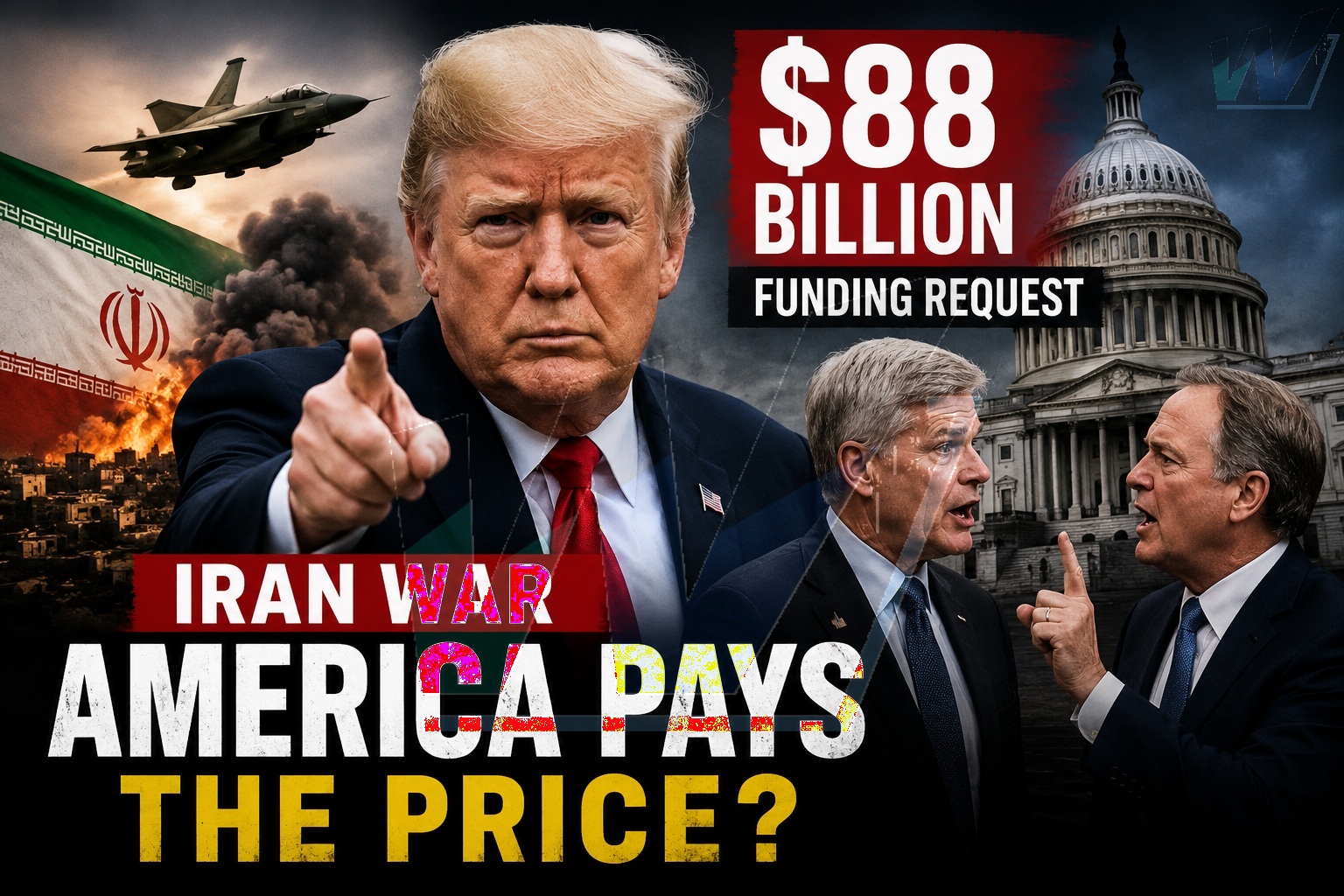
U.S. President Donald Trump has formally asked Congress for a staggering $87.6 billion emergency funding package, with the overwhelming majority aimed at sustaining and rebuilding America’s military operations tied to the war with Iran.
The request landed like a political missile.
And it may have detonated inside Trump’s own party.
For months, the conflict with Iran has rattled global markets, shaken energy supplies, and pushed oil traders into panic mode as fears over the Strait of Hormuz repeatedly sent prices surging. Now, as the White House attempts to sell a fragile diplomatic framework with Tehran, lawmakers from both parties are demanding answers.
The central question is no longer just how the war was fought.
It is becoming who will pay for it, and whether America was told the truth.
According to the White House supplemental request, roughly $67 billion would flow directly to the Pentagon. The package includes billions for munitions replenishment, operational expenses, classified defense programs, fuel, military readiness, cyber operations, and drone warfare capabilities. Additional funding is earmarked for U.S. farmers, Ebola containment efforts in Central Africa, and domestic infrastructure projects.
Yet the timing could not be worse.
Just one day earlier, Congress passed a symbolic, but politically explosive, resolution demanding that Trump halt hostilities against Iran unless lawmakers explicitly authorize further military action. While nonbinding, the message was unmistakable:
Patience is running out.
Then came the eruption.
Inside a closed-door lunch with Republican senators, tensions boiled over into a stunning confrontation between Trump and Republican Senator Bill Cassidy.
Witnesses described a shouting match so intensely that voices could reportedly be heard outside the meeting room.
Cassidy challenged Trump directly over the administration’s recent framework agreement with Tehran, a deal critics say offers economic incentives to Iran while failing to secure key original objectives, particularly concerning missile capabilities and long-term nuclear restrictions.
Cassidy pressed the president.
Where are the guarantees?
What exactly was achieved?
Why does the agreement appear to reward Tehran?
Trump fired back.
The exchange quickly escalated from disagreement into open confrontation.
Multiple reports describe Trump ordering Cassidy to sit down, while Cassidy continued pressing for clarity, warning that the American public had not been given the full picture.
After the meeting, Cassidy delivered a blunt message to reporters:
“The American people need to know more than we are being told.”
That sentence may define the political crisis now engulfing Washington.
Because beyond the military costs lies something even more dangerous for the White House:
Doubt.
Even among Republicans, skepticism is growing over whether the war achieved its stated strategic goals.
Trump originally framed the Iran campaign as a decisive effort to neutralize regional threats, weaken Tehran’s military infrastructure, and restore deterrence in the Middle East.
But critics argue the conflict instead exposed American vulnerabilities, strained military resources, and handed Iran leverage in negotiations.
Some conservative lawmakers are now calling the emerging settlement one of the most troubling foreign-policy reversals in decades.
Meanwhile, markets remain on edge.
Every development in U.S.–Iran diplomacy is now watched through the lens of oil, security, and military escalation. A collapse in negotiations could reignite attacks across the region, threaten shipping lanes, and trigger another surge in global energy prices.
And that is precisely why this funding request matters.
It is more than a budget bill.
It is a referendum on war itself.
The White House insists the money is essential to preserve readiness and maintain strategic deterrence. Trump allies argue failure to approve the package would weaken American leverage at the negotiating table and signal hesitation to adversaries.
Opponents see something else entirely.
They see an administration asking taxpayers to finance a conflict whose endgame remains dangerously unclear.
The road ahead in Congress looks brutal.
Democrats are expected to resist fiercely. Several Republicans remain uneasy. In the Senate, the administration may struggle to secure the votes needed to advance the measure.
That leaves Trump facing an uncomfortable reality:
He may still command the headlines.
But he no longer commands automatic loyalty.
As ceasefire talks inch forward and diplomacy hangs by a thread, one truth has become impossible to ignore—
The bombs may have stopped falling.
But the political war in Washington is only beginning.
And its next explosion could come not from Tehran…
…but from Capitol Hill.