The Secret Intelligence Trail Behind Tehran’s Precision Strikes
A shadow war inside the wider war
The question now emerging from the Iran conflict is no longer simply how far Tehran can strike.
It is whether Moscow may have helped Iran decide where to strike.
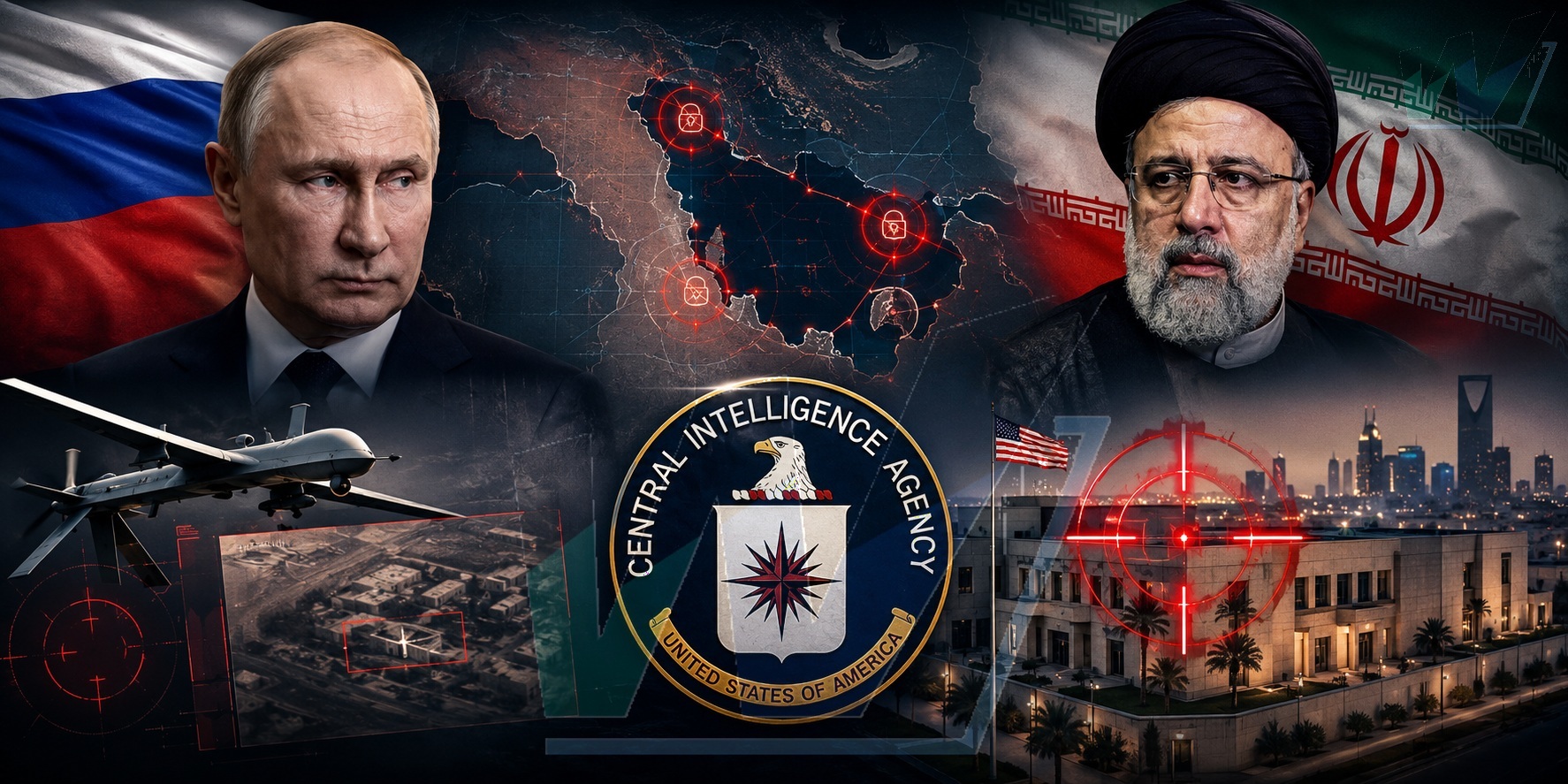
As the United States and Iran continue their escalating confrontation across the Middle East, U.S. intelligence agencies are investigating whether Russia provided Tehran with targeting information, satellite intelligence or advanced military technology that may have helped Iranian forces hit sensitive American intelligence facilities in the Gulf.
No definitive public conclusion has been reached. But this possibility has triggered a far more dangerous question inside Western intelligence circles:
Could Russia be quietly helping Iran hunt the American intelligence network across the Middle East?
Recent reporting by Reuters, alongside earlier accounts from The Washington Post, CNN and other major media outlets, indicates that U.S. intelligence officials are examining possible Russian assistance in attacks on CIA-linked facilities, including a CIA station located inside the U.S. Embassy complex in Riyadh, Saudi Arabia.
The allegations come as U.S. Secretary of State Marco Rubio met Russian Foreign Minister Sergey Lavrov in Manila, with the war in Ukraine officially dominating the diplomatic agenda. Yet behind the formal discussions lies another increasingly urgent issue: Russia’s expanding military and intelligence relationship with Iran, and its possible impact on the American war effort in the Gulf.
The Riyadh strike that changed the intelligence picture
The first major alarm surfaced in early March.
According to reporting by The Washington Post, two drones struck the U.S. Embassy complex in Riyadh. The attack reportedly damaged the CIA station operating inside the diplomatic compound. No CIA personnel were reported wounded, but the strike demonstrated that Iranian drones had reached one of the most sensitive American intelligence locations in the region.
The significance of the attack was enormous.
A strike against a visible U.S. embassy is one thing.
A strike that appears to hit a covert intelligence facility inside that compound is something else entirely.
Days later, The Washington Post reported that Russia had been providing Iran with intelligence on the locations of U.S. military assets in the Middle East, including American warships and aircraft. The report cited U.S. officials familiar with the intelligence.
CNN separately reported that Moscow had been helping Tehran locate American personnel and aircraft in the Gulf.
Then, in a new development reported by Reuters, U.S. intelligence analysts began examining whether Russian assistance may have extended beyond general battlefield intelligence to specific targeting of CIA facilities. The investigation remains incomplete, and officials have not reached a firm conclusion. But the precision and effectiveness of the strikes have intensified suspicions.
The central mystery: Did Iran know where the CIA was?
The CIA’s overseas facilities are among the most carefully protected secrets in the American national-security system.
Some are openly located inside U.S. embassies. Others operate through discreet offices, secure compounds, intelligence hubs and covert locations whose exact purpose and location are not publicly disclosed.
That is why the Riyadh attack has raised such serious questions.
Was Iran simply attacking the U.S. Embassy and happened to strike the CIA station?
Or did Iranian forces possess intelligence identifying the exact location of the intelligence facility?
According to Reuters, U.S. intelligence analysts are examining whether Russia provided targeting information connected to attacks on CIA facilities. Sources cited by the agency cautioned that the investigation had not produced a final determination. One possibility being considered is that Iran was targeting the embassy complex generally rather than the CIA station specifically.
But the alternative possibility is far more explosive.
If Moscow knowingly supplied intelligence that enabled Iran to strike CIA facilities, it would represent a significant escalation in Russian involvement in the conflict.
The Russian technology behind Iran’s Shahed drones
The investigation is not focused only on intelligence.
It is also examining whether Russia helped Iran improve the precision and survivability of the drones used in the attacks.
The Shahed-136 has become one of Iran’s most recognizable weapons exports. Since Russia’s full-scale invasion of Ukraine in 2022, Iranian-designed Shahed drones have played a major role in Russian attacks against Ukrainian cities and infrastructure.
That relationship, however, has increasingly become a two-way exchange.
Iran provided Russia with drones and other military assistance. Russia, in turn, has developed extensive combat experience in drone warfare, electronic warfare, satellite navigation and precision targeting.
One technology now at the center of the debate is the Kometa-M satellite-navigation system.
According to reporting previously attributed to The Wall Street Journal, Russia supplied Iran with the system, which can improve a drone’s ability to navigate in environments where satellite signals are jammed or disrupted. Moscow rejected those reports as “fake news.”
But the issue resurfaced after debris from an Iranian Shahed drone recovered following an attempted attack on a British RAF facility in Cyprus was reportedly found to contain the Russian navigation technology.
If confirmed, such technology could give Iranian drones a major advantage in the most heavily contested electronic-warfare environment in the world.
The question for U.S. intelligence officials is therefore becoming increasingly precise:
Did Russia merely help Iran improve its drones, or did it help Tehran aim them at specific American targets?
Russia’s satellites versus Iran’s intelligence networks
The theory of Russian assistance is based partly on a technological imbalance.
Iran possesses an extensive military drone and missile industry. It has developed sophisticated human-intelligence networks across the Middle East and maintains long experience operating through allied militias and regional partners.
But Russia possesses capabilities Iran has historically lacked at the same scale—particularly advanced space-based intelligence, satellite imagery and battlefield experience in precision targeting.
Analysts cited in reporting on the issue have argued that Russia’s space capabilities could provide Tehran with information about the movement and location of American aircraft, ships and military installations.
Yet experts also caution against assuming that every successful Iranian strike requires Russian assistance.
Iran has spent decades building its own intelligence infrastructure across the region. Its networks include human sources, surveillance operations, cyber capabilities and relationships with armed groups operating near American facilities.
In other words, the most plausible scenario may not be an either-or choice.
Russia may have supplied the technological edge, while Iran supplied the local intelligence.
The 20-year partnership that changed the equation
The allegations emerge against the backdrop of a rapidly deepening Russian-Iranian relationship.
In January 2025, Russian President Vladimir Putin and Iranian President Masoud Pezeshkian signed a 20-year Comprehensive Strategic Partnership Treaty. The agreement called for expanded cooperation in security, defense, military training, joint exercises and coordination between their security services.
The treaty, however, does not create a formal military alliance or require either country to automatically defend the other. Analysts at the Carnegie Endowment have emphasized that the agreement stops short of a NATO-style mutual-defense pact.
That distinction matters.
Russia and Iran are not legally bound to fight as a single military bloc.
But they increasingly share a common strategic enemy.
Both governments view the United States and its allies as the principal force blocking their ambitions in their respective regions. The war in Ukraine has accelerated that convergence.
Iran supplied Russia with drones used against Ukraine.
Russia has gained battlefield experience, technology and potentially intelligence-sharing capabilities.
Now, as Iran fights the United States and Israel, the partnership is being tested under conditions of open war.
Moscow’s possible motive: Help Iran survive, without entering the war
Russia has powerful reasons to avoid a direct military confrontation with the United States.
But it also has powerful reasons not to see Iran defeated.
A prolonged U.S.-Iran conflict could divert American military, intelligence and diplomatic resources away from Ukraine. It could also weaken Washington’s position in the Middle East and force the United States to divide its strategic attention between multiple theaters.
For Moscow, that may create a significant geopolitical opportunity.
The Kremlin could therefore seek a delicate balance:
Help Iran enough to survive.
Help Tehran make the war costly for Washington.
But avoid crossing the threshold into direct Russian-American war.
That may explain why intelligence support or technology transfers could be more attractive to Moscow than sending Russian forces into combat.
A satellite image is less visible than a Russian missile.
A navigation system is less provocative than a Russian fighter jet.
Yet both can change the battlefield.
The war is becoming a technological contest
The alleged Russian role also highlights a broader transformation of the conflict.
Iran is no longer relying only on ballistic missiles and conventional drone attacks.
The battlefield now involves:
- satellite imagery;
- electronic warfare;
- anti-jamming navigation systems;
- precision targeting;
- cyber operations;
- human intelligence;
- covert facilities;
- intelligence-sharing between rival powers.
The result is a conflict in which the most important weapon may not be the missile itself.
It may be the information that tells the missile where to go.
The U.S. intelligence community is therefore attempting to answer a question with enormous strategic consequences:
Was the attack on CIA facilities the result of Iranian intelligence alone—or the product of a wider Russian-Iranian intelligence partnership?
The evidence remains incomplete, but the concern is real
There is currently no publicly confirmed evidence proving that Russia directly ordered or controlled the strikes on CIA facilities.
U.S. intelligence officials have not reached a definitive conclusion, according to reporting cited by Reuters.
The Kremlin has denied previous reports concerning Russian technology on Iranian drones.
Iran has also not publicly acknowledged receiving Russian targeting data for specific CIA facilities.
And Iran has demonstrated its own ability to conduct sophisticated intelligence operations throughout the region.
But the intelligence investigation itself is significant.
The fact that U.S. agencies are examining possible Russian assistance indicates that the issue has moved beyond speculation in open-source analysis. The question is now reportedly being treated as a matter of national-security assessment.
A new front in the U.S.–Russia confrontation
The conflict in the Middle East is rapidly becoming connected to the war in Ukraine.
The same Russian-Iranian military relationship that helped Moscow develop and deploy Iranian-origin drones against Ukraine may now be providing Tehran with technology, battlefield lessons or intelligence that could threaten American forces in the Gulf.
Meanwhile, Rubio and Lavrov continue to speak about Ukraine.
But the geopolitical battlefield is expanding.
From Kyiv to Tehran, from Riyadh to the Gulf, the confrontation between Washington and Moscow is increasingly being fought through partners, technology and intelligence.
The question is no longer simply whether Russia and Iran are cooperating.
They clearly are.
The question now is how far that cooperation has gone.
And if Russian intelligence helped Iran locate the CIA’s most sensitive facilities in the Gulf, the next phase of the war may be fought not only with missiles and drones, but with a far more dangerous weapon: