WASHINGTON —
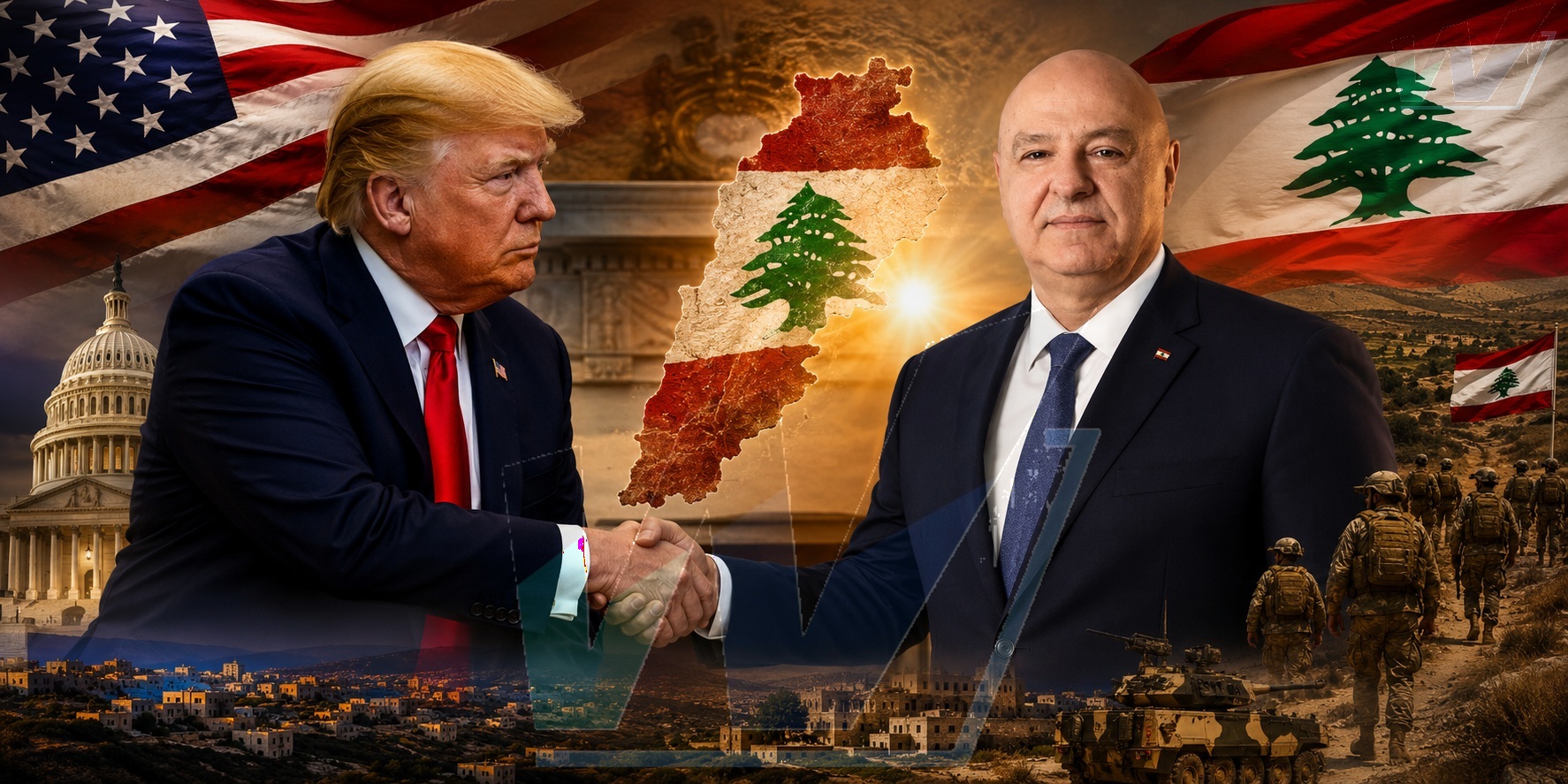
A potentially historic confrontation over Lebanon’s future moved from the battlefield to the Oval Office on Tuesday.
Lebanese President Joseph Aoun met U.S. President Donald Trump at the White House as Beirut began implementing a high-stakes security framework designed to reshape the balance of power in southern Lebanon — an agreement that links Israeli troop withdrawals to the Lebanese Army’s expansion of state control and the disarmament of Hezbollah.
Trump, speaking alongside Aoun, promised that the United States would help Lebanon after decades of conflict and political turmoil.
“Lebanon has been very badly treated,” Trump said, adding that Washington would ensure the country was treated with the respect it deserved. He also pointed directly to what he described as the central obstacle to Lebanon’s stability: the “Hezbollah problem.”
For Aoun, the meeting was far more than a diplomatic ceremony. It was a test of whether Washington is prepared to transform political support into concrete pressure, military assistance and financial backing at the very moment Lebanon is attempting to reclaim control over territory long dominated by Hezbollah.
A Deal with Two Fronts: Israeli Withdrawal and Hezbollah Disarmament
The stakes were raised dramatically by a framework agreement announced on June 26 under U.S. mediation.
The arrangement envisions a phased Israeli withdrawal from parts of southern Lebanon while the Lebanese Armed Forces expand their presence and assume responsibility for security. At the same time, Beirut is expected to move toward removing weapons and military infrastructure belonging to non-state armed groups, a provision widely understood to target Hezbollah.
The first test is already underway.
Israeli forces have begun withdrawing from several southern Lebanese locations designated as “pilot zones,” while Lebanese troops move into areas vacated by Israel. The initial zones include Froun, Srifa and Zawtar al-Gharbiya, with Washington watching closely to determine whether the arrangement can be expanded beyond the first limited phase.
The experiment is simple in theory, but explosive in practice.
Israel wants security guarantees and the removal of Hezbollah’s military infrastructure. Lebanon wants Israeli forces to leave its territory and wants the Lebanese state to regain exclusive authority over national security. Washington is attempting to force both objectives into the same diplomatic framework.
The danger is that failure on one side could collapse the entire structure.
Aoun Arrives in Washington with a Plan, and a Demand
Aoun’s visit marked the first trip by a Lebanese president to the White House in nearly two decades.
The former Lebanese Army commander arrived in Washington seeking U.S. support for a phased strategy to place all Lebanese territory under state authority, while also pressing Trump to ensure that Israel continues its withdrawal from southern Lebanon.
Before meeting Trump, Aoun held talks with Secretary of State Marco Rubio.
Rubio delivered an uncompromising message: Lebanon cannot achieve lasting peace while Hezbollah remains an armed force outside the control of the state. Washington has also urged Beirut to implement the framework agreement and build a government capable of exercising authority throughout the country.
But Aoun’s position is not simply an American blueprint.
The Lebanese president has repeatedly argued that the Hezbollah issue cannot be solved through force alone. The organization is not only a military structure, he has said, but also a deeply rooted political and social force. Any attempt to dismantle its power, therefore, would require a broader security, political and economic strategy.
That approach could become the defining fault line of the entire U.S.-backed initiative.
The Hezbollah Question: Disarmament Without Civil War
For decades, Hezbollah has maintained a military capability far beyond that of any ordinary Lebanese political party.
Its weapons have been defended by the group as necessary for resistance against Israel. Washington and Israel, however, regard Hezbollah as an Iranian-backed armed organization whose military power challenges the authority of the Lebanese state and poses a direct security threat.
The new framework attempts to resolve that contradiction.
But the most dangerous question remains unanswered: How can Lebanon disarm Hezbollah without triggering a new internal conflict?
Aoun has signaled that the process must be managed inside Lebanon and through a national strategy rather than imposed by foreign force. At the same time, pressure on Hezbollah is increasing as Beirut moves to expand army control in the south.
The group has strongly opposed efforts to strip it of its weapons and has criticized the Lebanese government’s direct engagement with Israel. Hezbollah figures have also escalated political attacks against the presidency, raising fears that the confrontation could increasingly shift from the southern battlefield into Lebanon’s political system.
The Lebanese Army, meanwhile, is moving carefully.
The government must demonstrate that the state can enforce its authority without igniting a confrontation with one of the country’s most powerful armed and political organizations.
That is the narrow path Aoun is attempting to walk.
Trump’s Role: Pressure, Protection and Reconstruction
Aoun’s strategy depends heavily on the United States.
Beirut wants Washington to use its influence over Israel to secure a full withdrawal from Lebanese territory. It also wants continued support for the Lebanese Armed Forces and international assistance for a country battered by war, economic collapse and mass displacement.
The Trump administration, meanwhile, wants evidence that Lebanon is serious about eliminating Hezbollah’s independent military power.
That creates a dramatic bargain.
Aoun is effectively asking Washington to help strengthen the Lebanese state while simultaneously pressuring Israel to leave Lebanese territory.
Trump is asking Lebanon to take on the most politically dangerous issue in the country: the future of Hezbollah’s weapons.
The result is a diplomatic equation in which every concession carries a risk.
If Israel withdraws without Hezbollah being disarmed, Israeli officials fear that the group could rebuild its military infrastructure near the border.
If Lebanon moves against Hezbollah before a credible Israeli withdrawal and security guarantee, Beirut risks provoking a confrontation that the Lebanese state may not be strong enough to control.
And if the framework collapses, the region could rapidly return to the cycle of escalation that has repeatedly transformed southern Lebanon into a battlefield.
A Historic Opportunity, or a Dangerous Gamble?
The Trump–Aoun meeting comes at a moment when the old regional order is under extraordinary pressure.
Lebanon is attempting to assert sovereignty over territory where the state has historically struggled to exercise full control. Israel is seeking security guarantees while maintaining military leverage. Hezbollah is facing unprecedented pressure over its armed status. Iran’s regional influence remains a central factor. And Washington is attempting to turn a fragile ceasefire framework into a permanent political settlement.
The success of the plan will depend on what happens after the cameras disappear.
Can the Lebanese Army expand its authority?
Will Israel continue its withdrawal?
Will Hezbollah accept a political process that could fundamentally reduce its military power?
And can the United States guarantee enough financial, military and diplomatic support to prevent Lebanon from being left alone with the consequences?
Those questions now hang over the next phase of the agreement.
For Joseph Aoun, the Washington mission is a defining moment.
For Donald Trump, it is another test of whether American pressure can turn a battlefield truce into a broader regional realignment.
For Lebanon, the stakes are existential.
The country is now standing between two possible futures: one in which the state gradually reclaims the monopoly over force and begins rebuilding its sovereignty, and another in which the struggle over Hezbollah’s weapons opens a new and potentially devastating chapter of conflict.
The first pilot zones may be small.
The consequences of what happens there could determine the future of the entire country.