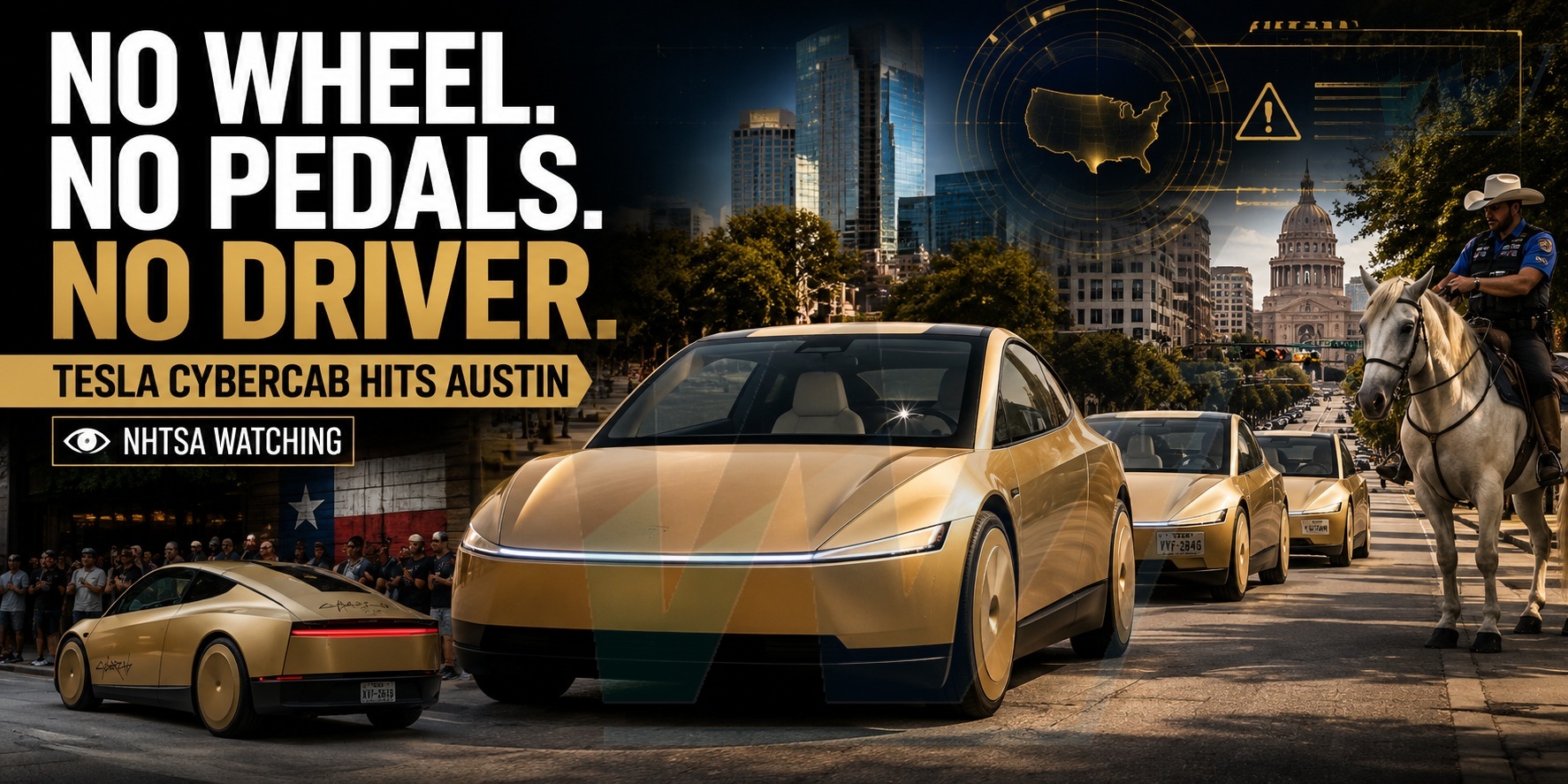
No Wheel. No Pedals. No Driver: Tesla Removes the Steering Wheel, and Puts Its Robotaxi Future on the Line
Elon Musk’s most radical Tesla gamble is finally on the road: a two-seat robotaxi with no steering wheel, no pedals and no human driver. But as Cybercabs begin carrying passengers in Austin, the biggest question may no longer be whether technology can drive itself, it’s whether regulators and the public are ready to let it.
AUSTIN, Texas — The steering wheel is gone. The pedals are gone. The driver is gone.
And now Tesla’s Cybercab is carrying passengers.
Tesla has begun offering rides in limited areas of Austin, Texas, with its futuristic two-seat electric robotaxi—a purpose-built vehicle designed to operate without conventional driving controls. The launch marks one of the boldest steps yet in Elon Musk’s long-running attempt to transform Tesla from an electric-car company into an autonomous transportation and artificial-intelligence giant.
But the celebration has already collided with a regulatory reality.
The U.S. National Highway Traffic Safety Administration (NHTSA) says it is evaluating Tesla’s Cybercab rollout after the vehicles entered service. The agency confirmed that it is in contact with Tesla, with particular attention drawn to a vehicle that lacks a steering wheel, pedals and mirrors—features generally covered by existing federal vehicle-safety requirements.
The car you cannot drive
Unlike Tesla’s existing robotaxi fleet, the Cybercab was designed from the beginning as a fully autonomous machine.
There is no steering wheel for a passenger to grab in an emergency. There are no brake pedals. The two-seat cabin is controlled through Tesla’s autonomous-driving technology and its Robotaxi ecosystem.
Tesla has been preparing Austin for the arrival of the production vehicle for months. Texas records show 45 Cybercabs registered for autonomous operations, within a larger autonomous-vehicle fleet operating in the state.
The company staged an exclusive launch event in Austin on September 3, surrounded by secrecy. Unlike Tesla’s traditionally theatrical product launches, the event was not livestreamed, journalists faced restrictions and attendees were reportedly subject to confidentiality requirements.
Tesla nevertheless made the message unmistakable: the Cybercab has moved from futuristic prototype to real-world service.
Musk’s biggest bet
For Musk, this is about far more than another Tesla model.
He has spent years arguing that autonomous driving could fundamentally change Tesla’s economics. Instead of simply selling cars, Tesla could eventually operate enormous fleets of robotaxis—or allow privately owned Teslas to earn money as autonomous taxis while their owners are not using them.
The Cybercab is intended to make that vision scalable.
Tesla has already operated a limited robotaxi service in Austin using Model Y vehicles, with some vehicles operating without human safety monitors. But the Cybercab represents a fundamentally different proposition: a vehicle built specifically for autonomous transportation, rather than a conventional car retrofitted with self-driving technology.
Tesla has also signaled ambitions to expand robotaxi operations beyond Austin, while eventually making autonomy a central pillar of the company’s future.
But Waymo is already ahead
The race is not starting from zero.
Waymo, Alphabet’s autonomous-driving company, remains far ahead in commercial robotaxi deployment. AP reports that Waymo operates more than 4,000 driverless vehicles across 14 cities, compared with Tesla’s much smaller unsupervised fleet.
Amazon-backed Zoox is another major competitor—and it has already moved into the steering-wheel-free category. Reuters reported in July that Zoox received U.S. approval for limited commercial deployment of paid robotaxis without conventional human controls.
The technological battle is also sharply divided.
Tesla has continued to champion a camera-based approach to autonomous driving. Waymo and Zoox use a broader combination of cameras, radar and lidar, a laser-based sensing technology designed to help vehicles perceive their surroundings.
That difference has become one of the defining technological debates in the autonomous-driving industry.
The safety question returns
The Cybercab arrives under a powerful spotlight because Tesla’s broader self-driving technology has already faced intense regulatory scrutiny.
U.S. authorities have investigated incidents involving Tesla vehicles operating with advanced driver-assistance features, including crashes in difficult visibility conditions and reports of vehicles violating traffic rules. NHTSA has also examined Tesla’s reporting of crashes involving its automated-driving systems.
Tesla’s existing Full Self-Driving technology is also fundamentally different from a truly driverless Cybercab: conventional Tesla owners remain responsible for monitoring the vehicle and being prepared to intervene.
The Cybercab removes that final layer of human control.
That makes the regulatory question dramatically more important.
Americans remain skeptical
Technology may be moving faster than public confidence.
A Pew Research Center survey cited by AP found that roughly seven in 10 U.S. adults were not too or not at all comfortable riding in a driverless vehicle. Only a small minority described themselves as extremely or very comfortable with the idea.
That creates a second hurdle for Musk.
Tesla must persuade regulators that the Cybercab is safe.
Then it must persuade passengers to step inside a vehicle where, in an emergency, they cannot simply take the wheel.
Tesla needs the Cybercab to work
The timing matters.
Tesla is attempting to accelerate its transition toward autonomy while facing pressure in its traditional electric-vehicle business. The company has experienced falling vehicle sales and intense competition, particularly from Chinese manufacturers, while investors increasingly view artificial intelligence, robotics and autonomous vehicles as central to Tesla’s long-term growth story.
That helps explain why the Cybercab has become so important.
Thursday’s launch produced an immediate market reaction: Tesla shares climbed more than 5% during the session as investors anticipated the event and the possibility of a major breakthrough in autonomous transportation.
But the stock-market enthusiasm now faces a tougher test.
Can Tesla turn a handful of futuristic vehicles into a reliable, profitable mass-market transportation network?
The road ahead
For now, Cybercab rides remain limited to parts of Austin.
The company has not yet demonstrated the scale Musk has promised, and the regulatory framework for vehicles without traditional controls remains a critical obstacle to wider deployment.
Yet the symbolic moment is enormous.
For more than a decade, Musk has promised a future in which cars drive themselves, passengers simply get in, and autonomous fleets generate revenue around the clock.
That future is no longer sitting behind glass at a technology demonstration.
It is moving through Austin traffic.
The Cybercab has arrived.
Now Tesla must prove that a car with no steering wheel can convince the world to let go of the wheel.